

I noted last week that a change in theology will lead to a change in relationships. What I meant is that what we think is true about God has implications for how we live.
Saul is a classic example. He thought of God as not Jesus, and thus those who worshipped Jesus as God were blasphemous idolaters. When God made clear that Jesus was God’s revelation of himself—Jesus, who said, “Father, forgive them, for they know not what they do” of those who denied, betrayed, and killed him—well, this had implications for how Paul would live.
We keep seeing this correction in Scripture. Remember how Peter had the vision to stop viewing Gentiles as unclean? In Galatians 2, Paul writes that Peter eventually stopped eating with Gentiles because of pressure from Jewish people to stop hanging out with uncircumcised people. Even Barnabas joined in. So, Paul corrected their behavior by correcting their view of God.
“We who are Jews by birth and not sinful Gentiles know that a person is not justified by the works of the law, but by faith in Jesus Christ. So we, too, have put our faith in Christ Jesus that we may be justified by faith in Christ and not by the works of the law, because by the works of the law no one will be justified.” (Galatians 2:15-16)
So in Christ Jesus you are all children of God through faith, for all of you who were baptized into Christ have clothed yourselves with Christ. There is neither Jew nor Gentile, neither slave nor free, nor is there male and female, for you are all one in Christ Jesus. (Galatians 3:26-28)
For the entire law is fulfilled in keeping this one command: “Love your neighbor as yourself.” If you bite and devour each other, watch out or you will be destroyed by each other. (Galatians 5: 14-15)
Wrong theology produces unrighteous segregation. Right theology produces shared tables. Let’s try another cause/effect in Romans.
“While we were enemies, we were reconciled to God by the death of his Son.” (Romans 5:10)
“Bless those who persecute you… do not repay evil for evil.” (Romans 12)
Paul grounds the love of enemies explicitly in God’s character revealed at the cross. If God reconciles enemies, his people cannot justify vengeance. A distorted image of God always produces distorted relationships. A healed vision of God will heal how we treat people.
If we move beyond the book of Acts and look at church history, there are a ton of examples. Let’s look at just two that were momentous in church formation. One will be bad; one will be good. They will highlight that we can tell what people think about God by looking at who they are willing to harm, and who they are determined to love.
Constantine
Under Constantine, Christians moved from a persecuted minority to being partners with the state. Their leaders began to argue that Rome’s agenda was the church’s agenda, which suggested that Rome’s way of bringing about its mission was sanctioned by God. (Constantine claimed a vision in which he saw a cross and the words, “In this sign, conquer.”) Followers of Jesus who had formerly refused to help Rome’s violent pax romana (peace by the sword) as it conquered the world and subjugated people, well, they now joined in.
Basically, Jesus moved from Lord over/against empire to Lord underwriting empire. The cross increasingly becomes reinterpreted as a sign of geo-political victory rather than an expression of self-giving love. Peace became defined as coercive stability (pax Romana) rather than the reconciled shalom of the Bible.
Meanwhile, church bishops gained political power. Because the church and state were so closely intertwined, church dissent became dangerous. Heresy moved from errors to be corrected to crimes to be punished.
Irenaeus (2nd Century) was the first person on record to define heresy. He simply warned about the dangers of a multitude of opinions on how God works.
The first person to make heresy a crime was Emperor Constantine (320s).
·The first recorded execution of a Christian heretic, Priscillian of Ávila, occurred in 385 by Roman secular authorities.
Once Jesus was imagined primarily as Cosmic Emperor with Constantine as an earthly representation, violence became thinkable “for the good.” Relationships change when theology changes.
The Reformation
The push to remember that justification is by faith, not works, was long overdue. The Reformers stressed the priesthood of all believers (1 Peter 2:9); we did not need mediators to have a relationship with God. We have Jesus. (1 Timothy 2:5) Because God was the kind of God who directly related to all believers, a couple changes followed.
Scripture was translated into the common language. It didn’t need to be filtered by those who could read Latin.
Vocational holiness was stressed (work, family, farming). There was dignity in all walks of life, not just ecclesiastical hierarchies.
Personal, pastoral care began to be emphasized over penitential systems. A personal, relational God wanted personal, relational people.
Whenever the church changes what it believes about God, it changes how it treats people.
In Acts, there are seven major speeches in chapters 2, 3, 7, 10, 13, 17, and 20. We now have four of them under our belt, so I think it’s time to look at what these speeches have in common. If you were to make a Venn Diagram with 7 bubbles, they would all overlap at some point, some more than others.
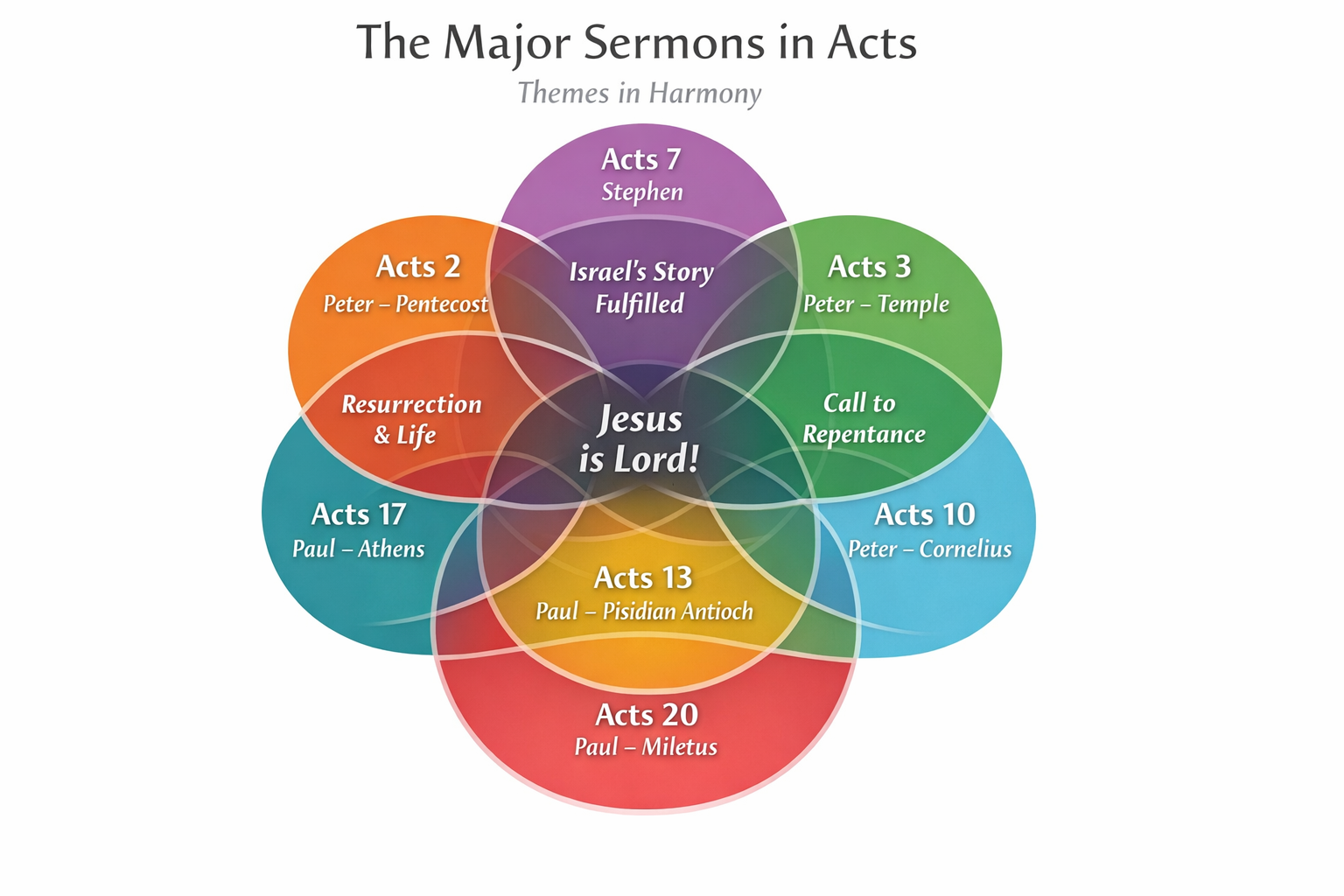
But there are actually more ‘sermons’ than that (Acts 2 14-40; 3:12-26; 4:5-12; 7; 10:28-47; 13:16-41;17:22-35; 20:17-35; 24:10-21). I couldn’t get them all on a Venn diagram, so let’s try a chart that will show how much they keep revisiting the same themes. (Keep in mind some audiences were Jewish and some Gentile, so things like Salvation History were only of interest to the Jews.)

We did a Harmony of the Gospels that combined the gospels (as best we could) into one harmonious flow. I am going to try to do that with the speeches this morning. Let’s read it, then we will discuss.
“Men and women, brothers and sisters, children of Abraham and Gentiles who fear God, hear these words.” [Acts 2:14; 13:16; 17:22]
“The God who made heaven and earth, the sea and everything in them, the God of our fathers and the giver of life to all peoples, has never been distant from what he has made.” [Acts 3:13; 17:24]
“From the beginning, he has been patient, faithful, and merciful, working through times and seasons so that people might seek him and find him, for he is not far from any one of us.” [Acts 17:26–27]
“From among the nations he called Abraham, and through Abraham he formed a people - not because they were great, but because he is good.” [Acts 7:2–8; 13:17]
“He bore with them in their rebellion, delivered them from slavery, walked with them through the wilderness, led them to the promised land, and spoke to them through the prophets. Again and again, God sent his servants, and again and again they were misunderstood, resisted, and rejected.” [Acts 7:9–52; 13:18–27]
“Yet God did not abandon his purpose, nor did human unfaithfulness cancel divine mercy. In the fullness of time, God sent Jesus of Nazareth, a man accredited by God to you by miracles, wonders and signs, which God did among you through him.” [Acts 2:22; 3:20; Acts 7:35–38;10:38;13:30]
“He went about doing good, healing the sick, restoring the broken, announcing good news to the poor and freedom from the power of the devil. God was with him.” [Acts 10:38; 2:22]
“Yet this Jesus was handed over. He was rejected by leaders, condemned unjustly, and put to death by human hands. But God raised him from the dead. Death could not hold him. The grave could not keep him.” [Acts 2:23-32; 3:13–15; 4:10; 10:40; 13:27–37; 17:31]
“By raising Jesus, God has done three things: First, he has vindicated the one we rejected and declared him to be Lord and Messiah. Salvation is found in no one else, for there is no other name under heaven given to mankind by which we must be saved.” [Acts 2:36; 4:10–12; 10:36]
“Second, he has confirmed all that the prophets spoke: suffering would not be the final word, that corruption would not triumph, and that God’s Holy One would see life again.” [Acts 3:18; 13:32–33; 26:22–23]
“And third, he has opened a new and living way not only for Israel,
but for all nations.” [Acts 10:34–35; 13:46–47; 15:7–11]“This risen Jesus has been exalted to the right hand of God, and from there he has poured out the Holy Spirit, not on the deserving, the powerful, or on people only, but on all whom God calls. We have seen it with our own eyes. God shows no favoritism.” [Acts 2:32-33; 10:39–47; 15:8–9]
“He now commands all people everywhere to repent, then, and turn to God. Everyone who believes in him is justified. Turn from what is empty, what enslaves, and turn to the living God.
This repentance leads to forgiveness of sins, to freedom from what the law could never fully remove. from the power of Satan, and to times of refreshing from the Lord.”
[Acts 2:38; 3:19, 38-39; 10:43; 13:39; 14:15; 15:1117:30; 26:18]“This same Jesus has been appointed by God as the one through whom the world will be set right. God has given proof of this to all by raising him from the dead.” [Acts 17:31; 24:15, 25]
“This message is for you and for those far away, for all whom the Lord our God will call. We do not preach ourselves or a new god; we proclaim what God has done through Jesus. So receive this grace, stand in this mercy, and walk in this new life.” [Acts 2:39-47; Acts 20:24-35; 26:22]
Demonstrate your repentance by your deeds. And we must help the weak, remembering the words the Lord Jesus himself said: ‘It is more blessed to give than to receive.’ ” (Acts 20:35; 26:20)
Acts gives an epic presentation of corrective truth about who God is, what God has done, and what God expects of His people. I suspect that every audience in Acts basically go their own Damascus Road experience. Notice the close – which has text from the last two sermons.
Demonstrate your repentance by your deeds. And we must help the weak, remembering the words the Lord Jesus himself said: ‘It is more blessed to give than to receive.’ ” (Acts 20:35; 26:20)
My claim at the beginning of this message is that a change of theology will bring about a change in relationships. The last two speeches make this clear. So, what kind of community emerges on the other side?
The Teaching The Change
God shows no favoritism Table fellowship across boundaries (Acts 10–11)
Jesus is Lord Allegiance above empire (Acts 17; 24)
Grace precedes law Gentiles included without Torah knowledge (Acts 15)
Spirit is poured out on all Shared life & generosity (Acts 2; 4)
Leaders serve Lives of humility, self-giving (Acts 20)
In Acts, acting righteously or justly is not an add-on to the gospel. It is the inevitable consequence of believing certain things about God. When the church confesses that God shows no partiality, welcomes outsiders, pours out His Spirit on all flesh, and saves by grace, our practices must match or our theology is exposed as incomplete.
I also made the claim that whenever the church changes what it believes about God, it changes who it is willing to harm—or to love. On the other side of the life of Jesus and the teaching in the book of Acts, who were early Christians willing to harm? No one. Who were they willing to love? Everybody. The Bible makes this clear, but I would like to show you the record from the church as it built on the foundation it had been given.
“This is the way of life: first, thou shalt love the God who made thee, secondly, thy neighbor as thyself: and all things whatsoever thou wouldest not should happen to thee, do not thou to another. The teaching of these words is this: Bless those who curse you, and pray for your enemies, and fast on behalf of those who persecute you. What thanks will be due to you, if ye love only those who love you? Do not the Gentiles also do the same? But love ye those who hate you, and ye shall not have an enemy.” (The Didache, also known as The Teachings of the 12 Apostles, a Christian document written between 80AD – 90AD.)
“We who formerly treasured money and possessions more than anything else now hand over everything we have to a treasury for all and share it with everyone who needs it. We who formerly hated and murdered one another now live together and share the same table. We pray for our enemies and try to win those who hate us.” (Justin the Martyr, 100AD – 165AD)
“It is the Christians, O Emperor, who have sought and found the truth, for they acknowledge God…. They show love to their neighbors. They do not do to another what they would not wish to have done to themselves. They speak gently to those who oppress them, and in this way they make them their friends. It has become their passion to do good to their enemies…. This, O Emperor, is the rule of life of the Christians, and this is their manner of life.” (Aristides, written around 137AD)
“For the Gentiles, hearing from our mouth the words of God, are impressed by their beauty and greatness: then, learning that our works are not worthy of the things we say, they turn to railing, saying that it is some deceitful tale. For when they hear from us that God says: ‘No thanks will be due to you, if ye love only those who love you; but thanks will be due to you, if ye love your enemies and those that hate you. When they hear this, they are impressed by the overplus of goodness: but when they see that we do not love, not only those who hate us, but even those who love us, they laugh at us, and the Name is blasphemed.” (The 2nd Epistle of Clement, 140-160AD)
“Say to those that hate and curse you, You are our brothers!” (Theophilus of Antioch, died around 185AD)
“The Christian does not hurt even his enemy.” (Tertullian, 160AD – 220AD)
“None of us offers resistance when he is seized, or avenges himself for your unjust violence, although our people are numerous and plentiful…it is not lawful for us to hate, and so we please God more when we render no requital for injury…we repay your hatred with kindness.” (St. Cyprian, Bishop of Carthage, died 258AD)
“Having cleansed ourselves of all hatred, it is necessary to love even enemies, and, when need be, to sacrifice one’s soul for one’s friends, having the same love as God and his Christ has for us.” (St. Basil the Great, 330–379 AD)
“Thus, in keeping with the commandment to rejoice with those who rejoice and weep with those who weep (Romans 12:15), we must open up our mercy to all the poor and those who suffer for whatever reason; we are to offer people charity, whether they are widowed or orphaned, whether they are driven out of their homeland or oppressed by the rulers, whether they suffer the insolence of their superiors or the inhumanity of tax collectors or the murderous hand of thieves or the greed of robbers or the seizing of estates or shipwrecks. For they all have the same right to our sympathy, and look at our hands just as we look at the hands of God when we ask Him for something.” (St Gregory the Theologian, 329 AD – 390 AD)
Do not love wealth if it does not help the poor. Forgive if you have received forgiveness, and be merciful if you have been pardoned. Acquire human love by human love while you are still alive. May your whole life be renewed. May your paths be made new. (St. Gregory the Theologian, 329 AD – 390 AD)
We learn a lot about what the first followers of Jesus assumed God required of them because of their understanding of what God was like as revealed in Jesus. If we assume that theology maps onto our relationships, I have a question. If someone watched my (your) relationships for a month, where we are ambassadors for God, what would they conclude about my (your) view of God? Is God…
Patient or harsh?
Generous or stingy?
More full of grace or judgment?
Slow to anger or quick to anger?
Punishment-centered or healing-centered?
Callous or kind?
Insulting or uplifting?
Manipulative or invitational?
Domineering or self-giving?
Keeping score or canceling debt?
Impatient with weakness or patient in formation?
Perfectionistic or growth-oriented?
Shaming people into change or loving them into it?
The book of Acts – and all of Scripture’s revelation of Jesus - offer an opportunity to assess whether or not we are living in the life Jesus has offered to us. Jesus modeled and taught a path to freedom from the power of sin and evil. He saves us not just from something but to something: a Kingdom characterized by righteousness and holiness. He invites us to join in his restorative plan for the world by demonstrating the beauty of the restoration that only Jesus can bring.
If you would like to put a song on your playlist that reflects this sermon, here it is.