
Acts 10

The Connection Between Theology and Relationships (Act 10 Continued…)

I noted last week that a change in theology will lead to a change in relationships. What I meant is that what we think is true about God has implications for how we live.

Saul is a classic example. He thought of God as not Jesus, and thus those who worshipped Jesus as God were blasphemous idolaters. When God made clear that Jesus was God’s revelation of himself—Jesus, who said, “Father, forgive them, for they know not what they do” of those who denied, betrayed, and killed him—well, this had implications for how Paul would live.

We keep seeing this correction in Scripture. Remember how Peter had the vision to stop viewing Gentiles as unclean? In Galatians 2, Paul writes that Peter eventually stopped eating with Gentiles because of pressure from Jewish people to stop hanging out with uncircumcised people. Even Barnabas joined in. So, Paul corrected their behavior by correcting their view of God.

“We who are Jews by birth and not sinful Gentiles know that a person is not justified by the works of the law, but by faith in Jesus Christ. So we, too, have put our faith in Christ Jesus that we may be justified by faith in Christ and not by the works of the law, because by the works of the law no one will be justified.” (Galatians 2:15-16)

So in Christ Jesus you are all children of God through faith, for all of you who were baptized into Christ have clothed yourselves with Christ. There is neither Jew nor Gentile, neither slave nor free, nor is there male and female, for you are all one in Christ Jesus. (Galatians 3:26-28)

For the entire law is fulfilled in keeping this one command: “Love your neighbor as yourself.”  If you bite and devour each other, watch out or you will be destroyed by each other. (Galatians 5: 14-15)

Wrong theology produces unrighteous segregation. Right theology produces shared tables. Let’s try another cause/effect in Romans.

“While we were enemies, we were reconciled to God by the death of his Son.” (Romans 5:10)

“Bless those who persecute you… do not repay evil for evil.” (Romans 12)

Paul grounds the love of enemies explicitly in God’s character revealed at the cross. If God reconciles enemies, his people cannot justify vengeance. A distorted image of God always produces distorted relationships. A healed vision of God will heal how we treat people.

If we move beyond the book of Acts and look at church history, there are a ton of examples. Let’s look at just two that were momentous in church formation. One will be bad; one will be good. They will highlight that we can tell what people think about God by looking at who they are willing to harm, and who they are determined to love.

Constantine

Under Constantine, Christians moved from a persecuted minority to being partners with the state. Their leaders began to argue that Rome’s agenda was the church’s agenda, which suggested that Rome’s way of bringing about its mission was sanctioned by God. (Constantine claimed a vision in which he saw a cross and the words, “In this sign, conquer.”) Followers of Jesus who had formerly refused to help Rome’s violent pax romana (peace by the sword) as it conquered the world and subjugated people, well, they now joined in.

Basically, Jesus moved from Lord over/against empire to Lord underwriting empire. The cross increasingly becomes reinterpreted as a sign of geo-political victory rather than an expression of self-giving love. Peace became defined as coercive stability (pax Romana) rather than the reconciled shalom of the Bible.

Meanwhile, church bishops gained political power. Because the church and state were so closely intertwined, church dissent became dangerous. Heresy moved from errors to be corrected to crimes to be punished.

  • Irenaeus (2nd Century) was the first person on record to define heresy. He simply warned about the dangers of a multitude of opinions on how God works.

  • The first person to make heresy a crime was Emperor Constantine (320s).

  • ·The first recorded execution of a Christian heretic, Priscillian of Ávila, occurred in 385 by Roman secular authorities.

Once Jesus was imagined primarily as Cosmic Emperor with Constantine as an earthly representation, violence became thinkable “for the good.” Relationships change when theology changes.

The Reformation

The push to remember that justification is by faith, not works, was long overdue. The Reformers stressed the priesthood of all believers (1 Peter 2:9); we did not need mediators to have a relationship with God. We have Jesus. (1 Timothy 2:5) Because God was the kind of God who directly related to all believers, a couple changes followed.

  • Scripture was translated into the common language. It didn’t need to be filtered by those who could read Latin.

  • Vocational holiness was stressed (work, family, farming). There was dignity in all walks of life, not just ecclesiastical hierarchies.

  • Personal, pastoral care began to be emphasized over penitential systems. A personal, relational God wanted personal, relational people.

Whenever the church changes what it believes about God, it changes how it treats people.

In Acts, there are seven major speeches in chapters 2, 3, 7, 10, 13, 17, and 20. We now have four of them under our belt, so I think it’s time to look at what these speeches have in common. If you were to make a Venn Diagram with 7 bubbles, they would all overlap at some point, some more than others.
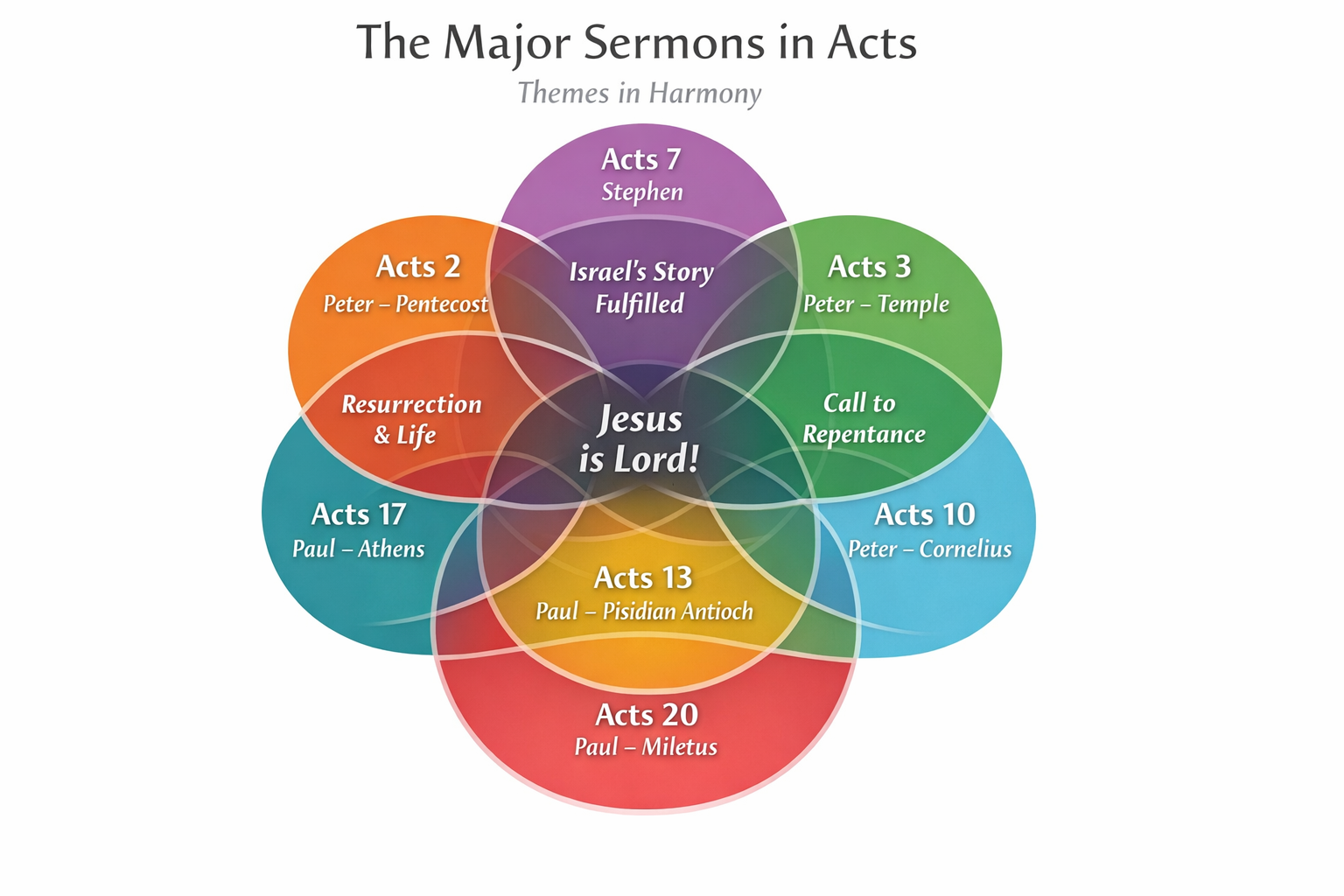
But there are actually more ‘sermons’ than that (Acts 2 14-40; 3:12-26; 4:5-12; 7; 10:28-47; 13:16-41;17:22-35; 20:17-35; 24:10-21). I couldn’t get them all on a Venn diagram, so let’s try a chart that will show how much they keep revisiting the same themes. (Keep in mind some audiences were Jewish and some Gentile, so things like Salvation History were only of interest to the Jews.)

We did a Harmony of the Gospels that combined the gospels (as best we could) into one harmonious flow. I am going to try to do that with the speeches this morning. Let’s read it, then we will discuss.

“Men and women, brothers and sisters, children of Abraham and Gentiles who fear God, hear these words.” [Acts 2:14; 13:16; 17:22]

“The God who made heaven and earth, the sea and everything in them, the God of our fathers and the giver of life to all peoples, has never been distant from what he has made.” [Acts 3:13; 17:24]

“From the beginning, he has been patient, faithful, and merciful, working through times and seasons so that people might seek him and find him, for he is not far from any one of us.” [Acts 17:26–27]

“From among the nations he called Abraham, and through Abraham he formed a people - not because they were great, but because he is good.” [Acts 7:2–8; 13:17]

“He bore with them in their rebellion, delivered them from slavery, walked with them through the wilderness, led them to the promised land, and spoke to them through the prophets. Again and again, God sent his servants, and again and again they were misunderstood, resisted, and rejected.” [Acts 7:9–52; 13:18–27]

“Yet God did not abandon his purpose, nor did human unfaithfulness cancel divine mercy. In the fullness of time, God sent Jesus of Nazareth, a man accredited by God to you by miracles, wonders and signs, which God did among you through him.” [Acts 2:22; 3:20; Acts 7:35–38;10:38;13:30]

“He went about doing good, healing the sick, restoring the broken, announcing good news to the poor and freedom from the power of the devil. God was with him.” [Acts 10:38; 2:22]

“Yet this Jesus was handed over. He was rejected by leaders, condemned unjustly, and put to death by human hands. But God raised him from the dead. Death could not hold him. The grave could not keep him.” [Acts 2:23-32; 3:13–15; 4:10; 10:40; 13:27–37; 17:31]

“By raising Jesus, God has done three things: First, he has vindicated the one we rejected and declared him to be Lord and Messiah. Salvation is found in no one else, for there is no other name under heaven given to mankind by which we must be saved.” [Acts 2:36; 4:10–12; 10:36]

“Second, he has confirmed all that the prophets spoke: suffering would not be the final word, that corruption would not triumph, and that God’s Holy One would see life again.” [Acts 3:18; 13:32–33; 26:22–23]

“And third, he has opened a new and living way not only for Israel,
but for all nations.” [Acts 10:34–35; 13:46–47; 15:7–11]

“This risen Jesus has been exalted to the right hand of God, and from there he has poured out the Holy Spirit, not on the deserving, the powerful, or on people only, but on all whom God calls. We have seen it with our own eyes. God shows no favoritism.” [Acts 2:32-33; 10:39–47; 15:8–9]

“He now commands all people everywhere to repent, then, and turn to God. Everyone who believes in him is justified. Turn from what is empty, what enslaves, and turn to the living God.

This repentance leads to forgiveness of sins, to freedom from what the law could never fully remove. from the power of Satan, and to times of refreshing from the Lord.”
[Acts 2:38; 3:19, 38-39; 10:43; 13:39; 14:15; 15:1117:30; 26:18]

“This same Jesus has been appointed by God as the one through whom the world will be set right. God has given proof of this to all by raising him from the dead.” [Acts 17:31; 24:15, 25]

“This message is for you and for those far away, for all whom the Lord our God will call. We do not preach ourselves or a new god; we proclaim what God has done through Jesus. So receive this grace, stand in this mercy, and walk in this new life.” [Acts 2:39-47; Acts 20:24-35; 26:22]

 Demonstrate your repentance by your deeds. And we must help the weak, remembering the words the Lord Jesus himself said: ‘It is more blessed to give than to receive.’ ” (Acts 20:35; 26:20)

Acts gives an epic presentation of corrective truth about who God is, what God has done, and what God expects of His people. I suspect that every audience in Acts basically go their own Damascus Road experience. Notice the close – which has text from the last two sermons.

Demonstrate your repentance by your deeds. And we must help the weak, remembering the words the Lord Jesus himself said: ‘It is more blessed to give than to receive.’ ” (Acts 20:35; 26:20)

My claim at the beginning of this message is that a change of theology will bring about a change in relationships. The last two speeches make this clear. So, what kind of community emerges on the other side?

The Teaching The Change

God shows no favoritism Table fellowship across boundaries (Acts 10–11)

Jesus is Lord                           Allegiance above empire (Acts 17; 24)

Grace precedes law Gentiles included without Torah knowledge (Acts 15)

Spirit is poured out on all Shared life & generosity (Acts 2; 4)

Leaders serve Lives of humility, self-giving (Acts 20)

In Acts, acting righteously or justly is not an add-on to the gospel. It is the inevitable consequence of believing certain things about God. When the church confesses that God shows no partiality, welcomes outsiders, pours out His Spirit on all flesh, and saves by grace, our practices must match or our theology is exposed as incomplete.

I also made the claim that whenever the church changes what it believes about God, it changes who it is willing to harm—or to love. On the other side of the life of Jesus and the teaching in the book of Acts, who were early Christians willing to harm? No one. Who were they willing to love? Everybody. The Bible makes this clear, but I would like to show you the record from the church as it built on the foundation it had been given.

“This is the way of life: first, thou shalt love the God who made thee, secondly, thy neighbor as thyself: and all things whatsoever thou wouldest not should happen to thee, do not thou to another. The teaching of these words is this: Bless those who curse you, and pray for your enemies, and fast on behalf of those who persecute you. What thanks will be due to you, if ye love only those who love you? Do not the Gentiles also do the same? But love ye those who hate you, and ye shall not have an enemy.” (The Didache, also known as The Teachings of the 12 Apostles, a Christian document written between 80AD – 90AD.)

“We who formerly treasured money and possessions more than anything else now hand over everything we have to a treasury for all and share it with everyone who needs it. We who formerly hated and murdered one another now live together and share the same table. We pray for our enemies and try to win those who hate us.” (Justin the Martyr, 100AD – 165AD)

“It is the Christians, O Emperor, who have sought and found the truth, for they acknowledge God…. They show love to their neighbors. They do not do to another what they would not wish to have done to themselves. They speak gently to those who oppress them, and in this way they make them their friends. It has become their passion to do good to their enemies…. This, O Emperor, is the rule of life of the Christians, and this is their manner of life.” (Aristides, written around 137AD)

“For the Gentiles, hearing from our mouth the words of God, are impressed by their beauty and greatness: then, learning that our works are not worthy of the things we say, they turn to railing, saying that it is some deceitful tale. For when they hear from us that God says: ‘No thanks will be due to you, if ye love only those who love you; but thanks will be due to you, if ye love your enemies and those that hate you. When they hear this, they are impressed by the overplus of goodness: but when they see that we do not love, not only those who hate us, but even those who love us, they laugh at us, and the Name is blasphemed.” (The 2nd Epistle of Clement, 140-160AD)

“Say to those that hate and curse you, You are our brothers!” (Theophilus of Antioch, died around 185AD)

“The Christian does not hurt even his enemy.” (Tertullian, 160AD – 220AD)

“None of us offers resistance when he is seized, or avenges himself for your unjust violence, although our people are numerous and plentiful…it is not lawful for us to hate, and so we please God more when we render no requital for injury…we repay your hatred with kindness.” (St. Cyprian, Bishop of Carthage, died 258AD)

“Having cleansed ourselves of all hatred, it is necessary to love even enemies, and, when need be, to sacrifice one’s soul for one’s friends, having the same love as God and his Christ has for us.” (St. Basil the Great, 330–379 AD)

“Thus, in keeping with the commandment to rejoice with those who rejoice and weep with those who weep (Romans 12:15), we must open up our mercy to all the poor and those who suffer for whatever reason; we are to offer people charity, whether they are widowed or orphaned, whether they are driven out of their homeland or oppressed by the rulers, whether they suffer the insolence of their superiors or the inhumanity of tax collectors or the murderous hand of thieves or the greed of robbers or the seizing of estates or shipwrecks. For they all have the same right to our sympathy, and look at our hands just as we look at the hands of God when we ask Him for something.” (St Gregory the Theologian, 329 AD – 390 AD)

Do not love wealth if it does not help the poor. Forgive if you have received forgiveness, and be merciful if you have been pardoned. Acquire human love by human love while you are still alive. May your whole life be renewed. May your paths be made new. (St. Gregory the Theologian, 329 AD – 390 AD)

We learn a lot about what the first followers of Jesus assumed God required of them because of their understanding of what God was like as revealed in Jesus. If we assume that theology maps onto our relationships, I have a question. If someone watched my (your) relationships for a month, where we are ambassadors for God, what would they conclude about my (your) view of God? Is God…

  • Patient or harsh?

  • Generous or stingy?

  • More full of grace or judgment?

  • Slow to anger or quick to anger?

  • Punishment-centered or healing-centered?

  • Callous or kind?

  • Insulting or uplifting?

  • Manipulative or invitational?

  • Domineering or self-giving?

  • Keeping score or canceling debt?

  • Impatient with weakness or patient in formation?

  • Perfectionistic or growth-oriented?

  • Shaming people into change or loving them into it?

The book of Acts – and all of Scripture’s revelation of Jesus - offer an opportunity to assess whether or not we are living in the life Jesus has offered to us. Jesus modeled and taught a path to freedom from the power of sin and evil. He saves us not just from something but to something: a Kingdom characterized by righteousness and holiness. He invites us to join in his restorative plan for the world by demonstrating the beauty of the restoration that only Jesus can bring.

If you would like to put a song on your playlist that reflects this sermon, here it is.

Clean and Unclean (Acts 9:20 – Acts 10)

Today’s section goes from Acts 9:20 through the end of chapter 10. We don’t have time to read all of the text, so I am going to give you some highlights and encourage you to read all of it yourself. We may revisit parts of it later, but today we need the bigger narrative.  Here is a quick overview before we unpack some of the details.

In Acts 9, after Paul’s encounter with Ananias, he sticks around and does some proclamation of Jesus as Lord. The local Jewish people try to kill him (I’m guessing it’s his former colleagues), but he escapes. He goes to Jerusalem and meets a bunch of the disciples who, as you might imagine, were skeptical. A guy named Barnabas smooths things over. That name will come up later.  The section on Paul ends this way:

Then the church throughout Judea, Galilee and Samaria enjoyed a time of peace and was strengthened. Living in the fear of the Lord and encouraged by the Holy Spirit, it increased in numbers. (Acts 9:31)

The narrative returns to Peter. He is on the move, and He is crushing it. He’s preaching. He heals a paralyzed man, and,

“All those who lived in Lydda and Sharon saw him and turned to the Lord.” (Acts 9:35)

He raises a woman named Tabitha (Dorcas, in Greek) from the dead. The people love him, and,

“This became known all over Joppa, and many people believed in the Lord.” (9:43)

Then Peter decides to stay with a local tanner (9:44), a guy who was constantly ritually unclean because he handled dead animals. It seems like an odd choice… until it doesn’t. We’ll get to that.

He gets this vision of a sheet descending from heaven with clean and unclean[1] animals mixed together. A voice says, “Get up, Peter. Kill and eat.”

So Peter, faithful adherent to Jewish purity laws, says, “Surely not, Lord.”

God says, “What I have made clean, you must not call unclean.” (Acts 10:13-15)

This happens three times, which is par for the course for Peter (3 denials that he knew Jesus; 3 challenges by Jesus of, "Do you love me?")

Meanwhile, God is speaking in a Roman house to a Gentile family (Acts 10). Cornelius, an important dude in the Roman army, is a praying, generous, devout God-fearer whom the Jewish people respect. Cornelius receives a vision to summon Peter, so he does.

When Peter gets there, he enters a house he was trained to avoid because of ritual impurity – but he had just been in a house like that, so some preparation had been done. There, he announces a tradition - shattering truth:

“God has shown me that I should not call any person common or unclean.” (Acts 10:28)

Then he starts preaching, and the Holy Spirit lands on them, and a bunch of folks get baptized. Then they invite Peter to stay and eat together with a bunch of Gentiles, and he does.

Peter is starting to look a lot like Jesus.

* * * * *

That’s the forest. Let’s look at some beautiful trees.

Healing is Unifying

Peter heals two people:

  • Aeneas had been paralyzed for eight years. He couldn’t worship in the temple (beyond the court of the Gentiles), and there was likely plenty of speculation about what sin he had committed to deserve that.

  • Tabitha/Dorcas was a disciple beloved by widows, known for good works and helping the poor. Listing both of her names likely highlights that this female disciple was a bridge-builder between the Jewish and Greek cultures.

These healings introduce a theme that’s going to continue in Acts 10.  God’s saving power is not limited by boundaries that create insiders and outsiders. And the restoration is not going to be merely physical. The result will be a building of a community of faith populated by people free of the hierarchy of value labels that traditions and cultures can enforce.

Peter Joins What God Is Already Doing

We talked about Saul’s zeal needing correction, which happened on the road to Damascus.  Now Peter is going to get some holy disruption concerning categories of people he considered clean and unclean.

To be fair to Peter, he’s giving it a go. He’s staying with a tanner, which Jewish people just did not do. There are dead animals, blood, hides, stench, impurity.

“A wife, it is said, could claim a divorce from a husband who became a tanner (Mishna Khethuboth): “It happened at Sidon that a tanner died, and left a brother who was also a tanner. The sages held that his (childless) widow had a right to plead, ‘Thy brother I could bear but I cannot bear thee.’” (Cambridge Bible For Schools And Colleges)

Let’s give Peter the benefit of the doubt. Maybe he’s testing himself. Maybe he’s trying to bring the tanner some honor by staying with him (like Jesus eating with Zaccheus). I don’t know.

Either way, the fact that he needs a vision suggests he hasn’t stopped putting people into categories of clean and unclean. So, he gets a vision of universal equality of human value in the eyes of God. He has to catch up with what God is already doing.

This continues in Acts 10 where, Cornelius doesn’t convert because Peter is persuasive; Cornelius responded to Peter’s message because God had prepared the way first. Cornelius already prayed, gave alms, and was a “God fearer,” a Jewish way of saying revered God. The Jewish people respected him. God was already at work.

 “Three days ago I was in my house praying at this hour, at three in the afternoon. Suddenly a man in shining clothes stood before me and said, ‘Cornelius, God has heard your prayer and remembered your gifts to the poor. Send to Joppa for Simon who is called Peter. He is a guest in the home of Simon the tanner, who lives by the sea.’ 

So I sent for you immediately, and it was good of you to come. Now we are all here in the presence of God to listen to everything the Lord has commanded you to tell us.” (Acts 10:30-33)

Then, the Holy Spirit manifested before Peter even finished his sermon (10:44).

While Peter was still speaking these words, the Holy Spirit came on all who heard the message. The circumcised believers who had come with Peter were astonished that the gift of the Holy Spirit had been poured out even on Gentiles. For they heard them speaking in different languages and praising God. (10:44-46)

It’s often viewed as a repeat of Pentecost, but this one is for the Gentiles.  There was no carefully orchestrated moment Peter had to create before the Holy Spirit was ready. Acts 10 is Pentecost without circumcision, without Torah observance, or without markers of “clean” and “unclean”. The Holy Spirit was way ahead of Peter.

Faithfulness is not about getting God to endorse our plans; faithfulness is recognizing where God is already at work and joining His mission.

Doctrinal change = relational change

Back to Peter’s vision. It wasn’t ultimately about food; it was about abolishing hierarchies of human worth. That was going to have massive implications about how Peter needed to interact with people. We are still on a theme of people zealous for God whose incorrect belief and practice – or both – need refinement.

Peter went inside and found a large gathering of people. He said to them: “You are well aware that it is against our law for a Jew to associate with or visit a Gentile. But God has shown me that I should not call anyone impure or unclean. So when I was sent for, I came without raising any objection.” (10:27-29)[2]

Their relationship is changing because their understanding of what God is like, and what God is doing, has changed. The story ends with table fellowship:

“They asked Peter to stay with them for several days.” (10:48)

Note the progression: Peter went from living with a tanner (unclean Jewish man) to being in a Gentile home (unclean Gentiles, double whammy)  - and then sharing a meal, which clearly sent a signal of value, dignity and worth.

The gospel doesn’t just save souls; it erases unrighteous categories of value and creates a community that shares a common feast at a common table.

Acts 10 is not the story of Gentiles becoming acceptable to God. It is the story of God teaching the church about those whom God has always invited to be a part of His Kingdom. Which, it turns out, is everybody.

Most of us don’t wrestle with kosher laws, but I am guessing there are ways we still have a tendency to label people and place “unclean” so that we can avoid them, critique them from a distance, and maybe even celebrate how much better we are. Meanwhile, God is already at work in them and is calling us to them: “Don’t call unclean what I have made clean.” 

Note that God said this of Cornelius before Peter went there and before Cornelius converted to faith specifically in Jesus. I think we need to make a distinction between different kinds of clean. There are a lot of verses about how the cross makes it possible for us to be clean because of the sacrificial provision of Jesus.

But if we walk in the light, just as he is in the light, we have fellowship with one another, and the blood of Jesus Christ, his Son, cleanses us from all sin. (1 John 1:7)

There is also a cleansing baptism done by the Holy Spirit:

[God] saved us, not because of works done by us in righteousness, but according to his own mercy, by the washing of regeneration and renewal of the Holy Spirit…” (Titus 3:5)

Cornelius and friends had not yet been washed by the regeneration and renewal of the Holy Spirit, so this category shift God makes clear to Pter must be something different.

I suspect it addressed the laws of ritual uncleanliness that insisted that Gentiles were so unclean almost by nature that they must be avoided entirely. This is not based on Torah teaching. The idea that Jews shouldn’t be in Gentile homes or eat at their table was a rabbinic tradition that began during the Second Temple period (516 BC to 70 AD).

God tells Peter that distinction is gone. There are no homes or tables he must avoid to be clean; no cities he dare not go to; no people who aren’t worthy enough to be invited into the Kingdom of God.

I wonder if we have lines drawn where the “clean” ends and the “unclean” begins.

  • It’s that group that has been so vilified that we just aren’t sure we should go to them with a message that God loves them and we do too.

  • It’s the people we just don’t want to have a meal with because we think our reputation might take a hit.

  • It’s those we fear have a spiritual darkness around them that’s so strong that we need to avoid them.

If I am reading the story of Cornelius correctly, the Holy Spirit is already standing on the other side of these lines waiting for us to catch up with the work the Holy Spirit is already doing.

We should be in contact with all people, because God is working them already. Isaiah records God saying,

“I made myself available to those who did not ask for me; I appeared to those who did not look for me.” (Isaiah 65:1)

They are, after all, His image bearers. He is not willing that any should perish, but that all would come to repentance (2 Peter 3:9), so He’s at work. I’m thinking now also of all the reports of dreams people are having in other countries preparing the way for the missionaries who arrive to introduce Jesus.[3]

When we embrace the reality that Jesus is already at work, our love and mercy will increasingly match the wideness of God’s love and mercy.

A couple questions for us to think about today as I invite us to join Jesus in the work He is already doing?

Where might God already be at work—healing, welcoming, and pouring out the Spirit—while I am still deciding who belongs, who’s clean, and whether I’m willing to enter their house?

Am I following the Spirit into unfamiliar places—or asking the Spirit to stay within my boundaries?”

Is my obedience shaped more by faithfulness to Jesus—or by comfort with people like me?


______________________________________________________________________________________

[1] As described in Old Testament Law

[2] Perhaps there are two miracles here: Cornelius received the Spirit, and Peter stopped resisting Him.

[3] “Have you seen The Man in White? Jesus is appearing to people in dreams” https://www.unreached.network/have-you-seen-the-man-in-white-jesus-is-appearing-to-people-in-dreams/

The Importance of Righteous Zeal (Acts 9; Philippians 3:4-6)

One of the things we talked about last Sunday[1] was Saul’s misplaced zeal. He genuinely believed he was carrying out God’s will by killing the first followers of The Way. He felt like the defender of the faith, the one with the most "biblical" backbone. He makes that clear in Philippians 3:5-6.

“…circumcised on the eighth day, of the people of Israel, of the tribe of Benjamin, a Hebrew of Hebrews; in regard to the law, a Pharisee; as for zeal, persecuting the church; as for righteousness based on the law, faultless.”

He was the one doing something about idolatry and what he perceived as a betrayal of the faith. He was tragically wrong.

When God stopped Saul on the road to Damascus, God didn’t correct Saul because he hadn’t memorized enough of the Torah, or because he lacked conviction and courage. He corrected Saul because Saul misunderstood what kind of Messiah Jesus is—and therefore what kind of kingdom Jesus brings. Part of his conversion was coming to grips with how badly he had misunderstood God and God’s plan in spite of having all the information he needed.

Then we talked about a few times historically when Christians sincerely believed they were doing God’s will but were, in fact, working against the heart of Christ: The Inquisition; the Crusades; the church’s long defense of slavery in the Southern states, etc.

In nearly every one of these moments, the church was not trying to rebel against God. Let’s give them the benefit of the doubt and assume they were convinced they were on the side of righteousness. Like Saul, they were not.  

I started thinking about times in my life where I saw a zeal for righteousness lose its way. I grew up in a denomination where churches split over what kind of covering women should wear, what Bible translation to use, and whether or not Christians would have to go through the tribulation. Yes, they were zealous for honoring Scripture (as they understood it), but surely the division it caused (and the message it sent to people hurt by these positions and arguments) was not what Jesus had in mind for his children.

I couldn’t shake the sense that we aren’t done with this topic. If sincere, Bible-believing Christians have been this wrong before, where might we need Jesus to lovingly interrupt us today?”[2]

To be clear, I love that this church is full of people zealous to follow Jesus. I’ve been here almost 30 years, and I have known some of you that long, and I know your zeal. It’s a beautiful thing. But if you have been here long enough, you’ve been through a whole lot of differences of opinion about how to live in the Kingdom, from worship styles in our Sunday Service, to responding to Covid, to our discussion about immigration and ICE last Sunday in Message+, and to a multitude of other things. We are a people zealous to follow Jesus, and we at times have remarkably different conclusions about what faithful discipleship looks like.

Sometimes, it’s disagreements over matters of personal conviction, aka, “If anyone, then, knows the good they ought to do and doesn’t do it, it is sin for them.”[3]  That’s fine; no Damascus Road intervention needed. But sometimes personal convictions were taught or defended as normative for all, and that needs a Damascus Road intervention to teach us something about humility and grace.

Other times, someone was right and someone was wrong about what Jesus is calling us to think and do. That can still happen. In those moments, we need Jesus to confront us on the road we are on.

So. I started a list of things sincere, zealous Christians disagree about, then went online to find what others were saying - and they had things to say. I have pared 15 pages of notes down to 9. As we go through just a portion of them, I want to challenge us to ask,

“Is it possible that I hold a position that reflects a misunderstanding about what it actually looks like for God’s Kingdom to come and His will to be done on earth as it is in heaven?“

Keep in mind that the issue will not be, ‘Does that person even care about God’s kingdom?’  Zeal for following Jesus will be assumed. The question for each of us to ask is,

“Does my zeal cause me to look more or less like Jesus, and my community to look more like His kingdom?”

I tried to end up with a list that will challenge all of us at some point - and maybe multiple points – to do one of two things:

  1. Challenge us to give grace because we’ve made our opinion a law when it ought to be an issue of conscience, or

  2. Challenge us to humility because we might be wrong.

Honestly, I kicked against the goads on this one. There are a lot of ways this could go wrong.  This list will be imperfect and incomplete. Don’t get hung up on things that don’t apply to you. But if the Holy Spirit starts to nudge you about one of these or something that didn’t make the list, I encourage you to be humble and responsive.

We start with the things closest to home. We have a deep, God-given desire to protect what is precious: our children, our bodies, and our health. This zeal is rooted in stewardship. That’s a great start. Does our zeal contain grace, and does it cause us to look more and more like Jesus?

Discipline

The zeal: We parents want to obey Scripture, raise godly children, and take discipline (correction) seriously, as we should.

The distortion: Authority can be emphasized without comfort and relationship, and behavior modification can replace spiritual formation. Some parents may fear using any firm correction because they associate discipline with past trauma or authoritarianism.

The Damascus Road Question. Does our discipline aim merely to control behavior, or to build authentic disciples? Does our zeal contain grace, and does it cause us to look more and more like Jesus?

Vaccines

The zeal: Protecting bodies and communities by getting vaccines and/or protecting autonomy and freedom by rejecting them

The danger: distrust of medical advice becoming unhealthy cynicism OR trust of medical advice becoming unquestioning loyalty.

Damascus Road question: If Jesus were physically present among believers who disagreed on this issue, would our words and posture look more like a conversation at a table of fellowship or more like tribal warfare? Does our zeal contain grace, and does it cause us to look more and more like Jesus?

Psychology vs. Faith for Emotional and Mental Healing

The zeal: Relying exclusively on spiritual maturity/supernatural healing OR relying exclusively on therapy and medicine.

The danger: Spiritualizing pain away or psychologizing sin away. One side fears that psychology denies sin (ignoring the soul's depravity).The other side fears that the church denies trauma (ignoring the body/mind's complexity).

Damascus Road question: Does our approach help people boldly bring their wounds to Jesus and others for healing, or would it cause them to hide and isolate out of shame for what we might say? Does our zeal contain grace, and does it cause us to look more and more like Jesus?


* * * * *

Beyond our homes, we have a zeal for our 'teams'—our nation, our politics, our people. But Saul's story warns us that when we commit ourselves to any identity flag other than Jesus (in Saul’s case, Jewish Pharisaism defended with Zealot means), we risk confusing the Empire’s culture with the way of the Kingdom.

Political Allegiance/Idolatry

The zeal: Wanting good leaders, biblically moral laws, and cultural stability.

The danger: Excusing sin in parties and people to gain cultural power; the temptation to baptize political strategies as “God’s plan”; defending the words and lives of leaders more fiercely than the teachings and the life model of Jesus.[4]

Damascus Road question: If Jesus refused to take the throne of the Empire to save the world, why do need the throne of the Empire to join in his mission? Does our zeal distract us from or cause us to bemore and more focused on Jesus?

Confusing the American Dream with the Kingdom of Heaven

The zeal: Gratitude for freedom, prosperity, and opportunity (which tracks with a just society).

The distortion: Material success, national identity, and personal advancement becoming signs of God’s Kingdom arriving.

Damascus Road question: Does our vision of a “blessed life” look more like Jesus’ Sermon on the Mount—or more like our culture’s promise of comfort, security, and upward mobility?[5] Does our zeal create a life in which we look more and more like Jesus?

Military Action to Stop Christian Persecution (e.g., Nigeria)

The zeal: Protecting persecuted believers, as we would like to be protected.

The danger: On the one side, are we failing to take the action we can to protect God’s persecuted children; on the other, are we trusting violence to do what resurrection love alone can do, and assuming Christ’s kingdom advances the same way empires do?

Damascus Road question: How would Jesus counsel us to protect his persecuted followers?[6] Does our zeal choose a path that looks like the path of Jesus?

Church as Prophetic Voice

The zeal: For the church to offer prophetic critiques of culture and pastoral care within existing cultural structures.

The danger: Becoming ideologically or politically captive to movements that give us platforms, prestige and power, then failing to speak gospel truth to power lest we lose our comfort and privilege.[7]

Damascus Road question: Are we consistently speaking Jesus’ Kingdom truth to the Empire’s power? Does our zealous message cause us to sound more and more like Jesus?

* * * * *

Many of us feel the fire of our zeal most when we see the brokenness of the world. We want to be the hands and feet of Jesus. This is a good impulse. Once again, does our zeal cause us to look more and more like Jesus? I offer one trend often associated with the Left, and one with the Right. In both cases, that challenge is how to respond when we start expecting the State to do the Church's work.

The Social Gospel

The zeal: A sincere concern for justice, the poor, the marginalized, and the oppressed.

The distortion: The fruit of the gospel being treated as the root of the gospel.[8]

Damascus Road Question: Are we proclaiming the same good news Jesus announced—repentance, reconciliation, and restoration—or only the practical outcomes of an embodied Kingdom? Does our zeal contain actions and words that point more and more clearly toward Jesus?

Christian Nationalism

The zeal: A desire to honor God publicly, preserve moral order, protect religious freedom, and see the nation flourish under righteousness.

The distortion: Confusing the Kingdom of God with national identity; prioritizing cultural dominance over cruciform witness.[9]

Damascus Road Question: Are we proclaiming allegiance to a cruciform King who will bring about Kingdom ends by Kingdom means, or are we looking to the Empire to bring about Kingdom ends by Empire means? Does our zeal refuse to step out of the ends and means of the kingdom, and does it cause us to look more and more like Jesus?

* * * * *

Finally, there is our zeal for the 'House of God.' We want to be orthodox. We want to protect the truth. But if our defense of the truth isn't characterized by the fruit of the Spirit, we may find ourselves like Saul: protecting the letter of the Law while dishonoring the heart of the Law – love - by trampling on God’s children. Does our zeal cause us to look more and more like Jesus?

Deconstruction vs…..Not Deconstruction

[Note: it seems like everyone describes deconstruction differently. Here’s what I mean: someone looks at their faith and sees something built shoddily on an unstable foundation because of bad teaching, hypocritical experiences, etc. They decide to tear it down. Some don’t start over and instead walk away. Others start rebuilding their faith, seeking a more stable foundation and more quality building material. This is about the Rebuilders.]

The zeal: On one side: protecting traditional orthodoxy, resisting relativism or cultural syncretism;. On the other: a zeal for authenticity, perhaps also a claim to protecting original orthodoxy; refusing to pretend everything is okay where there is doubt, hurt and confusion.

The danger: The danger for the defender is a defense of traditional orthodoxy without love or humility that might lead them to agree maybe not everything was what it should have been; the danger for the deconstructor who wants to rebuild is revisiting their faith without a humble curiosity that may lead them to reuse some of the material initially torn away..

Damascus Road question: Does our zeal contain both truth and grace that keep us humble and curious (as we always have more to learn), and does it cause us to look more and more like Jesus?

Christian Celebrity Culture

The zeal: Wanting strong leadership, gifted teaching, and effective ministry.

The danger: Confusing gifting with godliness, or excusing abuse because “God is using them.”[10]

Damascus Road question(s): Would Jesus recognize our definition of leadership as resembling His—washing feet, telling the truth, and laying down power—or something else entirely?[11] Does our zeal contain integrity, and does it cause us to look more and more like Jesus?

End-Times Fascination

The zeal: Taking Scripture seriously and longing for Christ’s return.

The danger: A fear-driven faith (when Revelation was meant to be hopeful!); moving from watchfulness to withdrawal and neglecting love, justice, and neighborliness now because it’s all gonna’ burn.

Damascus Road question: Does my focus on the future make me scared of the world, or does it make me care for my neighbor? Does our zeal for Christ’s return fuel loving outreach, and does it cause us to look more and more like Jesus?

* * * * *

In almost every case, the problem is not necessarily what followers of Jesus care about—it’s what we stop caring about. Maybe we stopped caring about people on the other side of an argument, and broke the bruised Isaiah said God would not break.[12] Maybe we are so zealous for a country to look like the Kingdom that we forgot the model of Jesus: sacrifice, love, invitation, example.

The most dangerous thing about being zealous for something is that it often feels indistinguishable from righteousness. Like Saul, we are sincere. Like Saul, we are certain. Like Saul, surely we are wrong in at least some ways in at least some places. And like Saul, we still need Jesus to stop us on the road when we misunderstand what kind of Messiah Jesus is – and, therefore, what kind of kingdom Jesus brings.

If Jesus is interrupting us today, I don’t believe His first words would be condemnation. As with Saul, I believe the first thing He would say would be our names, spoken tenderly, calling us to truth and healing by pointing us back to the nature, life and ministry of Jesus.


_____________________________________________________________________

[1] Acts 10

[2] Pete asked this question in Message +. Good work, Pete!

[3] James 4:17

[4] Zealous to defend our political side as the one that can bring the most good to the nation (good!), but not zealous to confront sin when it wears our team’s colors (not good).

[5] Zealous to enjoy God’s blessings and steward opportunity (good!), but not zealous to embrace the way of the cross when it costs comfort, status, or security (not good).

[6] Zealous to protect persecuted Christians (good!), but not zealous to ask whether the cross, rather than the sword, truly reveals the path of Jesus (not good).

[7] Zealous to be relevant or to be faithful (both good!), but not zealous to remain free from captivity to any power that competes with Jesus’ Kingdom (not good).

[8] Zealous to pursue justice, mercy, and good works (good!), but not zealous to proclaim reconciliation with God as the source of that work (not good).

[9] Zealous to preserve Christian influence and moral order (good!), but not zealous to follow Jesus when His way conflicts with national pride, political power, or cultural dominance (not good).

[10] Zealous to support gifted leaders and effective ministry (good!), but not zealous to insist on Christlike character, humility, and accountability as non-negotiable (not good).

[11] Would I defend or overlook this leader’s message, character and actions if they had no platform but were, instead, my next door neighbor, or led in my church?

[12] Isaiah 42:3; Matthew 12:20

Saul’s Misplaced Zeal (Acts 9, 22, 26)

 Back to Saul— breathing out threatenings and slaughter, who wanted to kill every last one of the Lord’s disciples: he went to the high priest in Jerusalem for authorization to purge all the synagogues in Damascus of followers of the way of Jesus. 

Christianity became known as The Way based on Christ calling Himself “the way” (John 14:6). It also reminds us that there is a path to following Christ. It’s not just a decision in a moment. It’s a lifestyle.[1]

 His plan was to arrest and chain any of Jesus’ followers—women as well as men[2]—and transport them back to Jerusalem. He traveled north toward Damascus with a group of companions.

Damascus was the middle of a huge commerce network, with trade stretching into Mesopotamia, Persia, and Arabia. If the new “Way” of Christianity flourished in Damascus, it would spread fast. To Saul, The Way had to be stopped in Damascus.[3]

Suddenly a light flashes from the sky around Saul, and he falls to the ground at the sound of a voice (speaking in Aramaic – Acts 26).[4] The Lord: Saul, Saul, why are you attacking Me?[5] It is hard for you to kick against the goads.” (Acts 26) Saul: Lord, who are You?

Goads are spikes used to prod farm animals.[6] Sometimes a stubborn ox kicks back against the goad and wounds itself. This proverb has to do with the pointlessness of rebelling against lawful authority.

The Lord: I am Jesus. I am the One you are attacking. Get up and stand on your feet. I have appeared to you to appoint you as a servant and as a witness of what you have seen and will see of me. Enter the city. You will learn there what you are to do. 

 I will rescue you from your own people and from the Gentiles. I am sending you to them to open their eyes and turn them from darkness to light, and from the power of Satan to God, so that they may receive forgiveness of sins and a place among those who are sanctified by faith in me.” (Acts 26) 

 His other traveling companions just stand there, paralyzed, speechless because they, too, heard the voice; but there is nobody in sight.  Saul rises to his feet, his eyes wide open, but he can’t see a thing. So his companions lead their blind friend by the hand and take him into Damascus. He waits for three days—completely blind—and does not eat a bite or drink a drop of anything. 

Meanwhile, in Damascus a disciple named Ananias had a vision in which the Lord Jesus spoke to him. (He was a devout observer of the law and highly respected by all the Jews living there. – Acts 22) The Lord: Ananias. Ananias: Here I am, Lord. 

Ananias was likely one of Saul's targets for arrest in Damascus. He served as first bishop of that city.[7]The Greek Church has a tradition that Ananias was one of the seventy-two disciples, and that he was martyred; they celebrate his martyrdom on the first of October.[8]

The Lord: Get up and go to Straight Boulevard. Go to the house of Judas, and inquire about a man from Tarsus, Saul by name. He is praying to Me at this very instant. He has had a vision—a vision of a man by your name who will come, lay hands on him, and heal his eyesight. 

Ananias: Lord, I know whom You’re talking about. I’ve heard rumors about this fellow. He’s an evil man and has caused great harm for Your special people in Jerusalem. I’ve heard that he has been authorized by the religious authorities to come here and chain everyone who associates with Your name. 

The Lord: Yes, but you must go! He is my chosen vessel to bring My name far and wide—to outsiders, to kings, and to the people of Israel as well. I have much to show him, including how much he must suffer for My name. So Ananias went and entered the house where Saul was staying. He laid his hands on Saul and called to him. 

 Ananias: Brother Saul, the Lord Jesus, who appeared to you on your way here, sent me so you can regain your sight and be filled with the Holy Spirit. (Acts 22 - “‘The God of our ancestors has chosen you to know his will and to see the Righteous One and to hear words from his mouth. 

 You will be his witness to all people of what you have seen and heard. And now what are you waiting for? Get up, be baptized and wash your sins away, calling on his name.” At that instant, something like scales fell from Saul’s eyes,[9]and he could see.  

So he got up, received the ceremonial washing of baptism identifying him as a disciple, ate some food (remember, he had not eaten for three days), and regained his strength. He spent a lot of time with the disciples in Damascus over the next several days.  

 Then he went into the very synagogues he had intended to purge, proclaiming, Saul: Jesus is God’s Son![10]


Let’s see what we can learn from Saul in this passage.   

“Saul, breathing out threatenings and slaughter.” That kind of language is also very frequent in the Greek writers, who use it to represent a remarkable amount of hostility.  Luke wrote in a sophisticated version of Greek called Koine Greek. It is likely he was trained in Greek classics. This kind of language is found often there. For example:

They came into the assembly, breathing mutual slaughter. (Theocritus)

They breathed spears, and pikes, and helmets, and crests, and greaves, and the fury of redoubted heroes. (Aristophanes)

His description of Saul shows someone desperately and incessantly bent on accomplishing the destruction of the objects of its resentment.[11]

Why was Saul so mad? He was convinced that Jesus was dead and buried. He did not believe the resurrection happened. As a Pharisee, a keeper of the law, he was bent on wiping out this idolatrous and blasphemous movement. You see a bit of zealotry shine through as he is determined to kill the enemies of his faith.[12] It’s not clear if he participated in the Zealot movement (as they generally targeted Rome), but his embrace of violence as a means of advancing or protecting God’s kingdom surely had some overlap.

So, envision Saul as a Jewish hero to probably all but the Essenes. He is a Pharisee, using the method of Zealots to kill these Jewish insurrectionists, which the Sadducees probably appreciated, since keeping their own people in line kept them in good standing with Rome.

I don’t think I can overstate this: Saul was profoundly convinced that he was God’s man doing God’s work. He told the church in Philippi,

“If someone else thinks they have reasons to put confidence in the flesh, I have more: circumcised on the eighth day, of the people of Israel, of the tribe of Benjamin, a Hebrew of Hebrews; in regard to the law, a Pharisee; as for zeal, persecuting the church; as for righteousness based on the law, faultless.” (Philippians 3:4-6)

That was his mindset when God confronted him: “I am crushing it. Surely God is pleased with me!” In this context, Jesus’ greeting to him is either obvious or shocking. “Saul, Saul,” is a repetition that signifies intimate personal address. Here are all the examples in Scripture other than God’s address to Saul.

 But the angel of the Lord called out to him from heaven,“Abraham! Abraham!” “Here I am,” he replied. (Genesis 22:11) 

And God spoke to Israel in a vision at night and said, “Jacob! Jacob!”

“Here I am,” he replied. (Genesis 46:2) 

God called to him from within the bush, “Moses! Moses!” And Moses said, “Here I am.” ( Exodus 34:4) 

The Lord came and stood there, calling as at the other times, “Samuel! Samuel!” Then Samuel said, “Speak, for your servant is listening.” (1 Samuel 3:10) 

“Martha, Martha,” the Lord answered, “you are worried and upset about many things…” (Luke 10:41) 

“Simon, Simon, Satan has asked to sift all of you as wheat. But I have prayed for you, Simon, that your faith may not fail. And when you have turned back, strengthen your brothers.” (Luke 22:31)

In all cases, it is not language of anger or condemnation. It is the gentle address of a caring Heavenly Father.  Here is Saul, violently hunting down and killing followers of Jesus, and Jesus “While we were yet sinners, Christ died for us,”[13] so of course Jesus loved him in the midst of his sin.

Meanwhile, Saul knows the OT, which is full of stories of God appearing to and speaking to people. This should be amazing for Saul: God is speaking to him! He must be doing GREAT!  But then Jesus says that Saul is actually persecuting him. (At that time, treatment of messengers reflected the attitude toward their sender.)[14]

It must have been overwhelming for Saul to do the math. If by persecuting the followers of Jesus he is persecuting God, then Jesus must be God, which means those pesky rumors about Jesus rising from the dead must be true.

It’s hard to imagine what was going on inside Saul.

In spite of all this, God calls him a “chosen vessel.”  It’s a very Jewish way of describing Saul as an excellent or well-adapted instrument, a choice or eminent person. How can this be? It turns out that Saul has attributes that, if applied to kingdom work, are fantastic.

  • His character: dedicated zealously to the purity of his faith  

  • His education: trained Jewish; trained in Greek by Roman benefactors, so primed to be all things to all people.

  • His reputation: stellar. He was the upcoming next big thing in his circles.

To the early Christians, Paul must have looked like a monster because of the outcome of his actions, and understandably so. As church history unfolds, we continue to see far too many times when zealous followers of God get His will terribly wrong. 

  • The Inquisition and other periods of intra-church violence, Christians believed they were protecting truth, saving souls, and guarding orthodoxy, yet used fear, coercion, imprisonment, and torture in the name of Christ. Even John Calvin had a man burned at the stake over theological differences.

  • Colonial missionary efforts toward Indigenous peoples, including the forced removal of Native American children into government and church-run schools in order to “kill the Indian and save the man.” Cultural erasure and family separation were framed as obedience to the Great Commission.

  • In the Crusades, nations and armies claimed to advance Christendom at the edge of the sword, and large segments of the church supported violence because they believed God’s kingdom would expand through conquest.

  • The church’s long defense of slavery. Scripture was quoted sincerely.
    Pulpits defended the system. Faithful Christians believed they were upholding God’s order—while denying the image of God in others.

  • Antisemitism within Christian theology and practice. People as famous as Martin Luther portrayed Jews as Christ-killers, cursed, or rejected by God. This theological zeal helped justify centuries of violence, exclusion, and persecution. (Hitler was a fan of Luther.)

  • The silencing of abuse “for the sake of the church.” Victims were told to forgive quickly. Leaders were protected to avoid scandal. What was framed as protecting God’s reputation often perpetuated harm.


In nearly every one of these moments, the church was not trying to rebel against God. The church believed it was being faithful – but it wasn’t.

To the victims in all of these circumstances, it must be really hard to see people doing terrible things under the banner of zealous allegiance to God and respond with imprecatory prayers and a desire for their destruction. And I totally get it. It’s a very human response to human rights violations.

But Jesus has a Jesus-like response to Paul (and I assume others who have sincerely used their power and skills in the belief they were doing God’s will, but were actually in the service of evil).

God sees what is possible on the other side of redemption. There is something here about hope and potential.

Don’t hear me say that God does not see what is happening in the moment. A God whose love is just will not be indifferent to injustice. God stopped Saul, after all. The Bible is clear that God is on the side of the oppressed.

Yet a God whose love is merciful and redemptive also knows what could happen in a surrendered and repentant heart, which is why God did not give up on Saul, and God will not give up on…..here you fill in the blank. Think big.

Immediately, God asks His people to trust that He can do transformational miracles. Paul seeks fellowship with the very people he was there to arrest. God could have informed him at once what His will was – He and Saul were having a conversation after all – but God chose to send Saul to God’s people. Why? Believer’s Bible Commentary offers two suggestions. I’m going to paraphrase:

  • First, so that those already in the Kingdom clearly understand the love and forgiveness God expects of them.

  • Second, so that those new to the kingdom experience the goodness of God through the goodness of God’s people.

Being a follower of Jesus is a high calling. Much has been given to us; much is required. It will be hard to love, forgive, confront, embrace, repent, be peacemakers; it’s a challenge to consistently show gentleness, meekness, and humility when we want so badly to be harsh, blustering, and proud.

Following in the path of Jesus is a high calling and a hard one. There’s a reason Jesus told his disciples to count the cost. (Luke 14:28-30) Following Jesus is a sacrifice that will cost us something if we take it seriously. But when we do, we introduce people to the goodness of God by living as faithful ambassadors of God.

And when you consider that kind of community, does it not sound like a beautiful place to be? A place built on the foundation of the cruciform love of Jesus, empowered by the Holy Spirit, and filled with people who increasingly remind us of Jesus. 

No wonder the next thing we read is that Paul began to testify powerfully (Acts 9:20). He had met Jesus; that was life-changing. And then he met the followers of Jesus who faithfully represented Jesus, and that was life-changing.  

* * * * *

Pastor: Lord, when we are full of zeal but mistaken about what You are actually calling us to…

Congregation: Slow us down, open our eyes, and turn our passion toward Your heart.

Pastor: When we are convinced we are defending You, yet our lives reveal fear, anger, pride, or harm…

Congregation: Remind us that You call us by name, not to shame us, but to heal us.

Pastor: When we are confident in our knowledge, our tradition, or our certainty…

Congregation: Teach us again that You are Jesus, the One we meet in mercy, the One we meet in truth.

Pastor: When our blindness is self-inflicted, when we kick against what You are doing in us…

Congregation: Give us the courage to stop resisting and the humility to be led by Your hand.

Pastor: When we struggle to believe that transformation is possible in others, or in ourselves…

Congregation: Remind us that You see not only what is, but also what can be made new.

Pastor: When You call us to love difficult people, to forgive deeply, to welcome boldly…

Congregation: Fill us with Your Spirit, so Your goodness is made visible through Your people.

Pastor: Lord Jesus, You met Saul on the road, You met him through Your people, and You sent him out with good news.

Congregation: As you meet us on our roads, may we respond by declaring Your mercy and Your light.  In the name of the Father, the Son, and the Holy Spirit, Amen.


[1] HT Orthodox Study Bible

[2] The fact that both men and women were targeted makes it clear that women had a prominent role in the early church. (Africa Bible Commentary)

[3] NIV Biblical Theology Study Bible

[4] My commentary crush Adam Clarke sees God using nature as a means of divine revelation: “Verse Acts 9:3.  This might have been an extraordinary flash of [lightning] accompanied with thunder… out of this thunder, or immediately after it, Christ spoke in a distinct voice, which appears to have been understood by Saul only.”

[5] To persecute Jesus’ disciples was to persecute Jesus (Matt. 5:10–12John 15:1920).

[6] “Sometimes used as a metaphor for the promptings of God (Ecc 12:11, “pointed sticks”).” (Orthodox Study Bible)

[7] Orthodox Study Bible

[8] Adam Clarke’s commentary

[9] Some of Luke’s audience may have recalled the scales or films that fell from Tobit’s eyes when he was healed in a traditional Jewish story (Tobit 3:17; 11:11 – 13). (NIV Cultural  Backgrounds Study Bible)

[10] This translation is The Voice, which you can find on Bible Gateway.

[11] Adam Clarke

[12] Paul describes himself several times as “zealous,” which has raised some questions about whether or not he was referencing Old Testament characters who were zealous for Got, the temple or the Torah, or if there was some sense in which he took the approach of the Zealots (who were Pharisees, though not all Pharisees were zealots.)

[13] Romans 5:8

[14] See Exodus 16:81 Samuel 8:7Luke 10:16).