

Well, we made it through another election. As was the case two years ago, I suspect some of you are pleased about the results and others are disappointed. I think we are all happy that the political commercials have finally stopped, and our mailboxes don’t give us so much material to start campfires.
This week, I was thinking about how, in my lifetime, pretty much every two years the tide changes color. A party with its people and priorities gets elected; usually, two years later there is some kind of reactionary vote, and a different party with its people and priorities gains power. Two years later, the tide changes color again….
When the ship of state moves that much, it can feel destabilizing, confusing, maybe even anxiety-inducing as we wonder what will happen in the next two years, then in the election two years from now. #changeyetagain
But we have an anchor. As always, whoever won the election, Jesus is still Lord. The results of an election may change who's in charge of the government, but they don't change who's in charge of the Kingdom of God. That means our calling as followers of Jesus hasn't changed either. Our call to be like Jesus stays steady. None of our Kingdom commitments change when the political landscape turns red or blue.
Two weeks ago, we talked about three important aspects of Christian discipleship: orthodoxy (right belief), orthopathy (righteous emotions), and orthopraxy (righteous actions). Last week, Paul reminded us that our character matters. The soul and the skin are connected. What we believe and what we love become visible in how we live.
God’s promise to complete the work He has begun in us by His Holy Spirit and through the death and resurrection of Jesus is the anchor, the through line. Transformation. Christlikeness. Ambassadorship. Ministers of reconciliation. Love God and love others. This grounds us and centers us.
Next week, we're returning to the book of Acts – literally about how the apostles and the early church acted. Before we do, I want to share some of what I was studying during my sabbatical which gave rise to the title of this sermon: “The Acts of Evangelicals.”
During my lifetime, evangelical leaders from around the world have been writing declarations about what it means to follow Jesus. Across generations, cultures, political administrations, and changing social controversies, they kept returning to many of the same convictions. I read:
· Chicago Declaration of Evangelical Social Concern (1973)
· Lausanne Covenant (1974)
· The Consultation on the Church in Response to Human Need, 1983,
· Manila Manifesto (1989)
· Amsterdam Declaration (2000)
· Health Of Our Nation (2004)
· Evangelical Manifesto of 2008
· Capetown Commitment (2010)
· For the Health of our Nation (2018)
· The Seoul Statement (2024)
While these declarations are certainly not inspired Scripture, they do seek to be faithful to Scripture. I think there's value in listening to what evangelical leadership across (literally) generations and cultures have consistently said about the implications of following Jesus. They represent the biblical and moral ecosystem in which many of us were raised, and in which this church was founded and continues to exist.[1]
(Other than the first one, which you can read in its entirety, I am excerpting portions related to orthopraxy and orthopathy that I hope give a representative overview.)
* * * * *
In 1973, around 50 evangelical leaders, notably Ron Sider, John Perkins, Carl F.H. Henry and Jim Wallis (who were theologically conservative and liberal), published the “Chicago Declaration of Evangelical Social Concern”. Here are some excerpts.
A DECLARATION OF EVANGELICAL SOCIAL CONCERN
As evangelical Christians committed to the Lord Jesus Christ and the full authority of the Word of God, we affirm that God lays total claim upon the lives of his people. We cannot, therefore, separate our lives in Christ from the situation in which God has placed us in the United States and the world.
We confess that we have not acknowledged the complete claims of God on our lives. We acknowledge that God requires love. But we have not demonstrated the love of God to those suffering social abuses.
We acknowledge that God requires justice. But we have not proclaimed or demonstrated his justice to an unjust American society. Although the Lord calls us to defend the social and economic rights of the poor and the oppressed, we have mostly remained silent. We deplore the historic involvement of the church in America with racism and the conspicuous responsibility of the evangelical community for perpetuating the personal attitudes and institutional structures that have divided the body of Christ along color lines. Further, we have failed to condemn the exploitation of racism at home and abroad by our economic system.
We affirm that God abounds in mercy and that he forgives all who repent and turn from their sins. So we call our fellow evangelical Christians to demonstrate repentance in a Christian discipleship that confronts the social and political injustice of our nation.
We must attack the materialism of our culture and the maldistribution of the nation's wealth and services. We recognize that as a nation we play a crucial role in the imbalance and injustice of international trade and development. Before God and a billion hungry neighbors, we must rethink our values regarding our present standard of living and promote more just acquisition and distribution of the world's resources.
We acknowledge our Christian responsibilities of citizenship. Therefore, we must challenge our misplaced trust of the nation in economic and military might – a proud trust that promotes a national pathology of war and violence which victimizes our neighbors at home and abroad. We must resist the temptation to make the nation and its institutions objects of near-religious loyalty.
We acknowledge that we have encouraged men to prideful domination and women to irresponsible passivity. So we call both men and women to mutual submission and active discipleship.
We proclaim no new gospel, but the Gospel of our Lord Jesus Christ who, through the power of the Holy Spirit, frees people from sin so that they might praise God through works of righteousness.
By this declaration, we endorse no political ideology or party, but call our nation's leaders and people to that righteousness which exalts a nation. We make this declaration in the biblical hope that Christ is coming to consummate the Kingdom and we accept his claim on our total discipleship till He comes.
They are painting with broad brush strokes, to be sure, but others will use a finer brush.
One year later, in 1974, 2,300 evangelicals from 150 nations crafted the Lausanne Covenant, with a focus on Christian mission that blends evangelism with social responsibility. This is going to be updated over the years, so I will give you some foundational principles here and look at details later.
We affirm that God is both the Creator and the Judge of all men. We therefore should share his concern for justice and reconciliation throughout human society and for the liberation of men and women from every kind of oppression. Because men and women are made in the image of God, every person, regardless of race, religion, colour, culture, class, sex or age, has an intrinsic dignity because of which he or she should be respected and served, not exploited….
Although reconciliation with other people is not reconciliation with God, nor is social action evangelism, nor is political liberation salvation, nevertheless we affirm that evangelism and socio-political involvement are both part of our Christian duty. For both are necessary expressions of our doctrines of God and Man, our love for our neighbour and our obedience to Jesus Christ. The message of salvation implies also a message of judgment upon every form of alienation, oppression and discrimination, and we should not be afraid to denounce evil and injustice wherever they exist… Faith without works is dead…
The development of strategies for world evangelization calls for imaginative pioneering methods. Under God, the result will be the rise of churches deeply rooted in Christ and closely related to their culture. Culture must always be tested and judged by Scripture. Because men and women are God’s creatures, some of their culture is rich in beauty and goodness. Because they are fallen, all of it is tainted with sin and some of it is demonic. The gospel does not presuppose the superiority of any culture to another, but evaluates all cultures according to its own criteria of truth and righteousness, and insists on moral absolutes in every culture...
The Manila Manifesto (1989) was produced and drafted by the British evangelical pastor and theologian John Stott, then finished by a task force of church leaders from around the world in Manila, including Billy Graham. It was overwhelmingly approved by over 4,000 participants from roughly 170 nations,[2] then published in 12 languages. A couple highlights:
Twenty-one Affirmations of the Manila Manifesto
1..We affirm our continuing commitment to The Lausanne Covenant as the basis of our cooperation in the Lausanne Movement.
2. We affirm that in the Scriptures of the Old and New Testaments God has given us an authoritative disclosure of his character and will, his redemptive acts and their meaning, and his mandate for mission.
3.We affirm that the biblical gospel is God’s enduring message to our world, and we determine to defend, proclaim, and embody it.
4.We affirm that human beings, though created in the image of God, are sinful and guilty, and lost without Christ, and that this truth is a necessary preliminary to the gospel.
5.We affirm that the Jesus of history and the Christ of glory are the same person, and that this Jesus Christ is absolutely unique, for he alone is God incarnate, our sin-bearer, the conqueror of death and the coming judge.
6.We affirm that on the cross Jesus Christ took our place, bore our sins and died our death; and that for this reason alone God freely forgives those who are brought to repentance and faith.
7.We affirm that other religions and ideologies are not alternative paths to God, and that human spirituality, if unredeemed by Christ, leads not to God but to judgment, for Christ is the only way.
8.We affirm that we must demonstrate God’s love visibly by caring for those who are deprived of justice, dignity, food, and shelter.
9.We affirm that the proclamation of God’s kingdom of justice and peace demands the denunciation of all injustice and oppression, both personal and structural; we will not shrink from this prophetic witness.
10.We affirm that the Holy Spirit’s witness to Christ is indispensable to evangelism, and that without this supernatural work neither new birth nor new life is possible.
11.We affirm that spiritual warfare demands spiritual weapons, and that we must both preach the Word in the power of the Spirit, and pray constantly that we may enter into Christ’s victory over the principalities and powers of evil.
12.We affirm that God has committed to the whole church and every member of it the task of making Christ known throughout the world; we long to see all lay and ordained persons mobilized and trained for this task.
13.We affirm that we who claim to be members of the body of Christ must transcend within our fellowship the barriers of race, gender, and class.
14.We affirm that the gifts of the Spirit are distributed to all God’s people, women and men, and that their partnership in evangelization must be welcomed for the common good.
15.We affirm that we who proclaim the gospel must exemplify it in a life of holiness and love; otherwise our testimony loses its credibility.
16.We affirm that every Christian congregation must turn itself outward to its local community in evangelistic witness and compassionate service.
17.We affirm the urgent need for churches, mission agencies, and other Christian organizations to cooperate in evangelism and social action, repudiating competition and avoiding duplication.
18.We affirm our duty to study the society in which we live, in order to understand its structures, values and needs, and so develop an appropriate strategy of mission.
19.We affirm that world evangelization is urgent and that the reaching of unreached peoples is possible. So we resolve during the last decade of the twentieth century to give ourselves to these tasks with fresh determination.
20.We affirm our solidarity with those who suffer for the gospel, and will seek to prepare ourselves for the same possibility. We will also work for religious and political freedom everywhere.
21.We affirm that God is calling the whole church to take the whole gospel to the whole world. So we determine to proclaim it faithfully, urgently, and sacrificially until he comes.
From Article 4, “The Gospel And Social Responsibility”
Evangelism is primary because our chief concern is with the gospel, that all people may have the opportunity to accept Jesus Christ as Lord and Saviour. Yet Jesus not only proclaimed the kingdom of God, he also demonstrated its arrival by works of mercy and power. We are called today to a similar integration of words and deeds. In a spirit of humility we are to preach and teach, minister to the sick, feed the hungry, care for prisoners, help the disadvantaged and handicapped, and deliver the oppressed. While we acknowledge the diversity of spiritual gifts, callings, and contexts, we also affirm that good news and good works are inseparable.
The proclamation of God’s kingdom necessarily demands the prophetic denunciation of all that is incompatible with it. Among the evils we deplore are destructive violence, including institutionalized violence, political corruption, all forms of exploitation of people and of the earth, the undermining of the family, abortion on demand, the drug traffic, and the abuse of human rights. In our concern for the poor, we are distressed by the burden of debt in the two-thirds world. We are also outraged by the inhuman conditions in which millions live, who bear God’s image as we do.
Our continuing commitment to social action is not a confusion of the kingdom of God with a Christianized society. It is, rather, a recognition that the biblical gospel has inescapable social implications. True mission should always be incarnational. It necessitates entering humbly into other people’s worlds, identifying with their social reality, their sorrow and suffering, and their struggles for justice against oppressive powers. This cannot be done without personal sacrifices.
Article 7, “The Integrity Of The Witness”
Nothing commends the gospel more eloquently than a transformed life, and nothing brings it into disrepute so much as personal inconsistency. We are charged to behave in a manner that is worthy of the gospel of Christ, and even to “adorn” it, enhancing its beauty by holy lives. For the watching world rightly seeks evidence to substantiate the claims which Christ’s disciples make for him. A strong evidence is our integrity.
Our proclamation that Christ died to bring us to God appeals to people who are spiritually thirsty, but they will not believe us if we give no evidence of knowing the living God ourselves, or if our public worship lacks reality and relevance.
Our message that Christ reconciles alienated people to each other rings true only if we are seen to love and forgive one another, to serve others in humility, and to reach out beyond our own community in compassionate, costly ministry to the needy.
Our challenge to others to deny themselves, take up their cross and follow Christ will be plausible only if we ourselves have evidently died to selfish ambition, dishonesty, and covetousness, and are living a life of simplicity, contentment, and generosity.
We deplore the failures in Christian consistency which we see in both Christians and churches: material greed, professional pride and rivalry, competition in Christian service, jealousy of younger leaders, missionary paternalism, the lack of mutual accountability, the loss of Christian standards of sexuality, and racial, social, and sexual discrimination. All this is worldliness, allowing the prevailing culture to subvert the church instead of the church challenging and changing the culture. We are deeply ashamed of the times when, both as individuals and in our Christian communities, we have affirmed Christ in word and denied him in deed. Our inconsistency deprives our witness of credibility. We acknowledge our continuing struggles and failures. But we also determine by God’s grace to develop integrity in ourselves and in the church.
From Article 12, “Difficult Situation”
First, Christians are loyal citizens, who seek the welfare of their nation. They pray for its leaders, and pay their taxes. Of course, those who have confessed Jesus as Lord cannot also call other authorities Lord, and if commanded to do so, or to do anything which God forbids, must disobey. But they are conscientious citizens. They also contribute to their country’s well-being by the stability of their marriages and their homes, their honesty in business, their hard work, and their voluntary activity in the service of the handicapped and needy. Just governments have nothing to fear from Christians.
Secondly, Christians renounce unworthy methods of evangelism. Though the nature of our faith requires us to share the gospel with others, our practice is to make an open and honest statement of it, which leaves the hearers entirely free to make up their own minds about it. We wish to be sensitive to those of other faiths, and we reject any approach that seeks to force conversion on them.
Thirdly, Christians earnestly desire freedom of religion for all people, not just freedom for Christianity. In predominantly Christian countries, Christians are at the forefront of those who demand freedom for religious minorities. In predominantly non-Christian countries, therefore, Christians are asking for themselves no more than they demand for others in similar circumstances. The freedom to ‘profess, practice, and propagate’ religion, as defined in the Universal Declaration of Human Rights, could and should surely be a reciprocally granted right.
We greatly regret any unworthy witness of which followers of Jesus may have been guilty. We determine to give no unnecessary offense in anything, lest the name of Christ be dishonored
Eleven years later, in 2000, Billy Graham brought together hundreds of international Christian leaders and evangelists from 8 nations to produce the Amsterdam Declaration. Before its final release, the text was collectively reviewed and shaped by hundreds of international Christian leaders representing the 10,000+ delegates from over 200 countries in attendance. Here are some highlights relevant to our focus.
Religious Pluralism and Evangelism
…In this global village of competing faiths and many world religions, it is important that our evangelism be marked both by faithfulness to the good news of Christ and humility in our delivery of it. Because God's general revelation extends to all points of his creation, there may well be traces of truth, beauty and goodness in many non- Christian belief systems. But we have no warrant for regarding any of these as alternative gospels or separate roads to salvation. The only way to know God in peace, love and joy is through the reconciling death of Jesus Christ the risen Lord. As we share this message with others, we must do so with love and humility, shunning all arrogance, hostility and disrespect. As we enter into dialogue with adherents of other religions, we must be courteous and kind. But such dialogue must not be a substitute for proclamation. Yet because all persons are made in the image of God, we must advocate religious liberty and human rights for all. (Romans 1:18-20; John 14:6; Acts 4:12; Mark 10:41-45; James 1:20; Genesis 1:26)
Although evangelism is not advocacy of any social program, it does entail social responsibility for at least two reasons. First, the gospel proclaims the kingship of the loving Creator who is committed to justice, to human life and the welfare of his creation. So evangelism will need to be accompanied by obedience to God's command to work for the good of all in a way that is fitting for the children of the Father who makes his sun shine on the evil and the good and sends his rain on the righteous and the unrighteous alike.
Second, when our evangelism is linked with concern to alleviate poverty, uphold justice, oppose abuses of secular and economic power, stand against racism, and advance responsible stewardship of the global environment, it reflects the compassion of Christ and may gain an acceptance it would not otherwise receive. (Psalm 47:7; 1 Timothy 6:15; Revelation 17:14; Galatians 6:10; Matthew 5:45; Deuteronomy 24:10-13, 14- 15; Luke 1:52-53, 4:18-19; James 5:1-6)
The National Evangelical Association released “For The Health of Our Nation” in 2004. The declaration restates what was and continues to be conservative evangelical perspectives on marriage, sexuality, and abortion while expanding the principles in ways you might not be used to hearing.
Because God created human beings in his image, every human life from conception to death bears the image of God and has inestimable worth (Genesis 1:27). Therefore, Christians must be committed to a consistent ethic of life that safeguards the essential nature of human life at all stages, with a special concern to protect the lives of the most vulnerable. The unborn, the very young, the aged, those living in poverty, the chronically or terminally ill, those with disabilities and those with genetic diseases deserve our particular care and protection. Our public policy agenda should reflect these broad commitments.
Good family life is so important to healthy human functioning that we oppose government efforts to trespass on the integrity of the family; for example, by encroaching on parental responsibilities and rights to educate their children, separating nuclear families through deportation or creating economic disincentives to marriage. Similarly, labor, housing, healthcare, tax, immigration and education policies concern not only individuals but can significantly affect families. We commit ourselves to work for laws that protect and foster family life. Violations of the integrity of the family threaten public order. In order to strengthen the family, we must promote biblical moral principles, responsible personal choices and wise public policies.
The declaration also had a lot to say about how our faith ought to be expressed in very practical ways to those around us.
We work to protect religious freedom and liberty of conscience.
God has ordained the two co-existing institutions of church and state as distinct and independent of each other with each having its own areas of responsibility (Rom. 13:1-7; Mark 12:13-17; Eph. 4:15-16, 5:23-32). We affirm the principles of religious freedom and liberty of conscience... As God allows the wheat and tares to grow together until the harvest, and as God sends the rain on the just and on the unjust, so those who obey and those who disobey God coexist in society and share in its blessings (Matt. 5:45, 13:24-30). This “gospel pluralism” is foundational to the religious liberty of all….
We work to nurture family life and protect children
Because the family is so important to society, violations of its integrity threaten public order. Similarly, employment, labor, housing, health care, and educational policies concern not only individuals but seriously affect families. In order to strengthen the family, we must promote biblical moral principles, responsible personal choices, and good public policies on marriage and divorce law, shelter, food, health care, education, and a family wage (Jas. 5:1-6)… We will work for measures that strengthen the economic viability of marriages and families, especially among the poor.
We seek justice and compassion for the poor and vulnerable
Jesus summed up God’s law by commanding us to love God with all that we are and to love our neighbors as ourselves (Matt. 22:35-40). By deed and parable, he taught us that anyone in need is our neighbor (Luke 10:29-37). Because all people are created in the image of God, we owe each other help in time of need.
God identifies with the poor (Ps. 146:5-9), and says that those who “are kind to the poor lend to the Lord” (Prov. 19:17), while those who oppress the poor “show contempt for their Maker” (Prov. 14:31). Jesus said that those who do not care for the needy and the imprisoned will depart eternally from the living God (Matt. 25:31-46). The vulnerable may include not only the poor, but women, children, the aged, persons with disabilities, immigrants, refugees, minorities, the persecuted, and prisoners. God measures societies by how they treat the people at the bottom.
God’s prophets call his people to create just and righteous societies (Isa. 10:1-4, 58:3-12; Jer. 5:26-29, 22:13-19; Amos 2:6-7; Amos 4:1-3, 5:10-15). The prophetic teaching insists on both a fair legal system (which does not favor either the rich or the poor) and a fair economic system (which does not tolerate perpetual poverty). Though the Bible does not call for economic equality, it condemns gross disparities in opportunity and outcome that cause suffering and perpetuate poverty, and it calls us to work toward equality of opportunity.
God wants every person and family to have access to productive resources so that if they act responsibly they can care for their economic needs and be dignified members of their community. Christians reach out to help others in various ways: through personal charity, effective faith-based ministries, and other nongovernmental associations, and by advocating for effective government programs and structural changes.
Economic justice includes both the mitigation of suffering and also the restoration of wholeness. Wholeness includes full participation in the life of the community. Health care, nutrition, and education are important ingredients in helping people transcend the stigma and agony of poverty and re-enter community….
Restoring people to wholeness means that governmental social welfare must aim to provide opportunity and restore people to self-sufficiency. While basic standards of support must be put in place to provide for those who cannot care for their families and themselves, incentives and training in marketable skills must be part of any well-rounded program. We urge Christians who work in the political realm to shape wise laws pertaining to the creation of wealth, wages, education, taxation, immigration, health care, and social welfare that will protect those trapped in poverty and empower the poor to improve their circumstances.
We further believe that care for the vulnerable should extend beyond our national borders. American foreign policy and trade policies often have an impact on the poor. We should try to persuade our leaders to change patterns of trade that harm the poor and to make the reduction of global poverty a central concern of American foreign policy. We must support policies that encourage honesty in government, correct unfair socioeconomic structures, generously support effective programs that empower the poor, and foster economic development and prosperity. Christians should also encourage continued government support of international aid agencies, including those that are faith based.
Especially in the developing world, extreme poverty, lack of health care, the spread of HIV/AIDS, inadequate nutrition, unjust and unstable economies, slavery and sexual trafficking, the use of rape as a tool of terror and oppression, civil war, and government cronyism and graft create the conditions in which large populations become vulnerable. We support Christian agencies and American foreign policy that effectively correct these political problems and promote just, democratic structures.
We work to protect human rights
Because God created human beings in his image, we are endowed with rights and responsibilities…. As recipients of God’s gift of embodied life, people need food, nurture, shelter, and care. In order to fulfill their God-given tasks, all people have a right to private property. God’s design for human existence also implies a right to marry, enjoy family life, and raise and educate children.
While it is not the primary role of government to provide everything that humans need for their well-being, governments are obligated to ensure that people are not unjustly deprived of them and to strengthen families, schools, businesses, hospitals, social-service organizations, and other institutions so they can contribute to human welfare…
America has a tragic history of mistreating Native Americans, the cruel practice of slavery, and the subsequent segregation and exploitation of the descendants of slaves. While the United States has achieved legal and social equality in principle, the legacy of racism still makes many African Americans, Hispanics, and other ethnic minorities particularly vulnerable to a variety of social ills. Our churches have a special responsibility to model good race relations (Rom. 10:12). To correct the lingering effects of our racist history, Christians should support well-conceived efforts that foster dignity and responsibility.
We seek peace and work to restrain violence
…from the beginning, Christians have recognized that God did not call them to bring in God’s kingdom by force. While all Christians have agreed that governments should protect and restore just and peaceful social orders, we have long differed on when governments may use force and whether we may participate in government-authorized force to defend our homelands, rescue others from attack, or liberate other people from oppression.
The peaceful settling of disputes is a gift of common grace. We urge governments to pursue thoroughly nonviolent paths to peace before resorting to military force. We believe that if governments are going to use military force, they must use it in the service of peace and not merely in their national interest. Military force must be guided by the classical just-war principles, which are designed to restrain violence by establishing the right conditions for and right conduct in fighting a war. In an age of nuclear and biological terrorism, such principles are more important than ever.
We urge followers of Jesus to engage in practical peacemaking locally, nationally, and internationally. As followers of Jesus, we should, in our civic capacity, work to reduce conflict by promoting international understanding and engaging in non-violent conflict resolution.
We labor to protect God’s creation
…God gave the care of his earth and its species to our first parents. That responsibility has passed into our hands. We affirm that God-given dominion is a sacred responsibility to steward the earth and not a license to abuse the creation of which we are a part. We are not the owners of creation, but its stewards, summoned by God to “watch over and care for it” (Gen. 2:15). This implies the principle of sustainability: our uses of the Earth must be designed to conserve and renew the Earth rather than to deplete or destroy it….
Just as we show our love for the Savior by reaching out to the lost, we believe that we show our love for the Creator by caring for his creation. Because clean air, pure water, and adequate resources are crucial to public health and civic order, government has an obligation to protect its citizens from the effects of environmental degradation. This involves both the urgent need to relieve human suffering caused by bad environmental practice…
Human beings have responsibility for creation in a variety of ways. We urge Christians to shape their personal lives in creation-friendly ways: practicing effective recycling, conserving resources, and experiencing the joy of contact with nature. We urge government to encourage fuel efficiency, reduce pollution, encourage sustainable use of natural resources, and provide for the proper care of wildlife and their natural habitats.
In 2008, 80 evangelical leaders, including Os Guinness and Dallas Willard, released an Evangelical Manifesto.[3] More than any other previous ones, there is a fairly intense focus on our faith and politics.
We believe that being disciples of Jesus means serving him as Lord in every sphere of our lives, secular as well as spiritual, public as well as private, in deeds as well as words, and in every moment of our days on earth, always reaching out as he did to those who are lost as well as to the poor, the sick, the hungry, the oppressed, the socially despised, and being faithful stewards of creation and our fellow-creatures…
What we are about is captured not only in books or declarations, but in our care for the poor, the homeless, and the orphaned; our outreach to those in prison; our compassion for the hungry and the victims of disaster; and our fight for justice for those oppressed by such evils as slavery and human trafficking...
Evangelicalism must be defined theologically and not politically; confessionally and not culturally. Above all else, it is a commitment and devotion to the person and work of Jesus Christ, his teaching and way of life, and an enduring dedication to his lordship above all other earthly powers, allegiances and loyalties. As such, it should not be limited to tribal or national boundaries, or be confused with, or reduced to political categories such as “conservative” and “liberal,” or to psychological categories such as “reactionary” or “progressive…”
All too often we have abandoned our Lord’s concern for those in the shadows, the twilight, and the deep darkness of the world, and become cheerleaders for those in power and the naïve sycophants of the powerful and the rich…
We call for an expansion of our concern beyond single-issue politics, such as abortion and marriage, and a fuller recognition of the comprehensive causes and concerns of the Gospel, and of all the human issues that must be engaged in public life… we must follow the model of Jesus, the Prince of Peace, engaging the global giants of conflict, racism, corruption, poverty, pandemic diseases, illiteracy, ignorance, and spiritual emptiness, by promoting reconciliation, encouraging ethical servant leadership, assisting the poor, caring for the sick, and educating the next generation…
…The other error, made by both the religious left and the religious right in recent decades, is to politicize faith, using faith to express essentially political points that have lost touch with biblical truth. That way faith loses its independence, the church becomes “the regime at prayer,” Christians become “useful idiots” for one political party or another, and the Christian faith becomes an ideology in its purest form. Christian beliefs are used as weapons for political interests...
Christians from both sides of the political spectrum, left as well as right, have made the mistake of politicizing faith…Whichever side it comes from, a politicized faith is faithless, foolish, and disastrous for the church – and disastrous first and foremost for Christian reasons rather than constitutional reasons...
Called to an allegiance higher than party, ideology, and nationality, we Evangelicals see it our duty to engage with politics, but our equal duty never to be completely equated with any party, partisan ideology, economic system, or nationality. In our scales, spiritual, moral, and social power are as important as political power, what is right outweighs what is popular, just as principle outweighs party, truth matters more than team-playing, and conscience more than power and survival...
The politicization of faith is never a sign of strength but of weakness. The saying is wise: “The first thing to say about politics is that politics is not the first thing.” The Evangelical soul is not for sale. It has already been bought at an infinite price...
Let it be known unequivocally that we are committed to religious liberty for people of all faiths, including the right to convert to or from the Christian faith. We are firmly opposed to the imposition of theocracy on our pluralistic society… In contrast to these extremes, our commitment is to a civil public square — a vision of public life in which citizens of all faiths are free to enter and engage the public square on the basis of their faith, but within a framework of what is agreed to be just and free for other faiths too. Thus every right we assert for ourselves is at once a right we defend for others. A right for a Christian is a right for a Jew, and a right for a secularist, and a right for a Mormon, and right for a Muslim, and a right for a Scientologist, and right for all the believers in all the faiths across this wide land…
We utterly deplore the dangerous alliance between church and state, and the oppression that was its dark fruit. We Evangelicals trace our heritage, not to Constantine, but to the very different stance of Jesus of Nazareth. While some of us are pacifists and others are advocates of just war, we all believe that Jesus’ Good News of justice for the whole world was promoted, not by a conqueror’s power and sword, but by a suffering servant emptied of power and ready to die for the ends he came to achieve.
We urge those who share our dedication to the poor, the suffering, and the oppressed to join with us in working to bring care, peace, justice, and freedom to those millions of our fellow-humans who are now ignored, oppressed, enslaved, or treated as human waste and wasted humans by the established orders in the global world.
In 2010, the Cape Town Commitment emerged from the Third Lausanne Congress on World Evangelization. It brought together 4,200 evangelical leaders from 198 countries. Once again, we see some new language that reflects what were increasingly front-and-center cultural issues.
“To resist the multiple forms of disordered sexuality in our surrounding cultures, including pornography, adultery and promiscuity; To seek to understand and address the deep heart issues of identity and experience which draw some people into homosexual practice; to reach out with the love, compassion and justice of Christ, and to reject and condemn all forms of hatred, verbal or physical abuse, and victimization of homosexual people…”
HIV and AIDS constitute a major crisis in many nations. Millions are infected with HIV, including many in our churches, and millions of children are orphaned by AIDS. God is calling us to show his deep love and compassion to all those infected and affected and to make every effort to save lives. We believe that the teachings and example of Jesus, as well as the transforming power of his cross and resurrection, are central to the holistic gospel response to HIV and AIDS that our world so urgently needs.
We reject and denounce all condemnation, hostility, stigma, and discrimination against those living with HIV and AIDS. Such things are a sin and a disgrace within the body of Christ. All of us have sinned and fallen short of God’s glory; we have been saved only by grace, and we should be slow to judge, quick to restore and forgive. We also recognize with grief and compassion that very many people become infected with HIV through no fault of their own, and often through caring for others.
We long that all pastors should set an example of sexual chastity and faithfulness, as Paul commanded, and teach clearly and often that marriage is the exclusive place for sexual union. This is needed not only because it is the clear teaching of the Bible, but also because the prevalence of concurrent sexual partnerships outside marriage is a major factor in the rapid spread of HIV in the most affected countries.
Let us, as the Church worldwide, rise to this challenge in the name of Christ and in the power of the Holy Spirit. Let us stand together with our brothers and sisters in areas hardest hit by HIV and AIDS, through practical support, compassionate care (including care of widows and orphans), social and political advocacy, education programmes (particularly those that empower women), and effective prevention strategies appropriate to the local context. We commit ourselves to such urgent and prophetic action as part of the integral mission of the Church."
Aside from the extensive re-stated commitment to orthodox evangelical pillars of faith, there is so much in this statement on orthopraxy.
Such love for God’s creation demands that we repent of our part in the destruction, waste and pollution of the earth’s resources and our collusion in the toxic idolatry of consumerism. Instead, we commit ourselves to urgent and prophetic ecological responsibility….
We love the world of nations and cultures. ‘From one man, God made all nations of humanity, to live on the whole face of the earth.’ Ethnic diversity is the gift of God in creation…[it]reflects God’s promise to bless all nations on earth and God’s mission to create for himself a people drawn from every tribe, language, nation and people. We must love all that God has chosen to bless, which includes all cultures… Such love for all peoples demands that we reject the evils of racism and ethnocentrism, and treat every ethnic and cultural group with dignity and respect, on the grounds of their value to God in creation and redemption.
We love the world’s poor and suffering. The Bible tells us that the Lord is loving toward all he has made, upholds the cause of the oppressed, loves the foreigner, feeds the hungry, sustains the fatherless and widow… God holds responsible especially those who are appointed to political or judicial leadership in society, but all God’s people are commanded…to reflect the love and justice of God in practical love and justice for the needy.
Such love for the poor demands that we not only love mercy and deeds of compassion, but also that we do justice through exposing and opposing all that oppresses and exploits the poor….We give ourselves afresh to the promotion of justice, including solidarity and advocacy on behalf of the marginalized and oppressed. We recognize such struggle against evil as a dimension of spiritual warfare that can only be waged through the victory of the cross and resurrection, in the power of the Holy Spirit, and with constant prayer.
We love our neighbours as ourselves. Jesus called his disciples to obey this commandment as the second greatest in the law, but then he radically deepened the demand ‘love the foreigner as yourself’ into ‘love your enemies’.
Such love for our neighbours demands that we respond to all people out of the heart of the gospel, in obedience to Christ’s command and following Christ’s example. This love for our neighbours embraces people of other faiths, and extends to those who hate us, slander and persecute us, and even kill us….We emphatically reject the way of violence in the spread of the gospel, and renounce the temptation to retaliate with revenge against those who do us wrong… At the same time, our loving duty towards our suffering neighbours requires us to seek justice on their behalf through proper appeal to legal and state authorities who function as God’s servants in punishing wrongdoers.
We acknowledge with grief and shame the complicity of Christians in some of the most destructive contexts of ethnic violence and oppression, and the lamentable silence of large parts of the Church when such conflicts take place. Such contexts include the history and legacy of racism and black slavery; the holocaust against Jews; apartheid; ‘ethnic cleansing’; inter-Christian sectarian violence; decimation of indigenous populations; inter-religious, political and ethnic violence; Palestinian suffering; caste oppression; and tribal genocide…
We… call for repentance for the many times Christians have been complicit in such evils by silence, apathy or presumed neutrality, or by providing defective theological justification for these.
If the gospel is not deeply rooted in the context, challenging and transforming underlying worldviews and systems of injustice, then, when the evil day comes, Christian allegiance is discarded like an unwanted cloak and people revert to unregenerate loyalties and actions. Evangelizing without discipling, or revival without radical obedience to the commands of Christ, are not just deficient; they are dangerous.
We embrace the witness of the whole Bible, as it shows us God’s desire both for systemic economic justice and for personal compassion, respect and generosity towards the poor and needy….
Have courage to declare that the world cannot address, let alone solve, the problem of poverty without also challenging excessive wealth and greed. The gospel challenges the idolatry of rampant consumerism. We are called, as those who serve God and not mammon, to recognize that greed perpetuates poverty, and to renounce it.
We lament over the widespread abuse and destruction of the earth’s resources, including its bio-diversity. Probably the most serious and urgent challenge faced by the physical world now is the threat of climate change. This will disproportionately affect those in poorer countries, for it is there that climate extremes will be most severe and where there is little capability to adapt to them. World poverty and climate change need to be addressed together and with equal urgency. We encourage Christians worldwide to…
adopt lifestyles that renounce habits of consumption that are destructive or polluting; B) Exert legitimate means to persuade governments to put moral imperatives above political expediency on issues of environmental destruction and potential climate change…
We commit ourselves to be scrupulously ethical in all our evangelism. Our witness is to be marked by ‘gentleness and respect, keeping a clear conscience.’ We therefore reject any form of witness that is coercive, unethical, deceptive, or disrespectful.
In the name of the God of love, we repent of our failure to seek friendships with people of Muslim, Hindu, Buddhist and other religious backgrounds. In the spirit of Jesus, we will take initiatives to show love, goodwill and hospitality to them.
In the name of the God of truth, we (i) refuse to promote lies and caricatures about other faiths, and (ii) denounce and resist the racist prejudice, hatred and fear incited in popular media and political rhetoric.
In the name of the God of peace, we reject the path of violence and revenge in all our dealings with people of other faiths, even when violently attacked.
People are on the move as never before. Migration is one of the great global realities of our era. It is estimated that 200 million people are living outside their countries of origin, voluntarily or involuntarily. The term ‘diaspora’ is used here to mean people who have relocated from their lands of birth for whatever reason. Some relocate permanently, and others, like three million international students and scholars, temporarily. Vast numbers of people from many religious backgrounds, including Christians, live in diaspora conditions: economic migrants seeking work; internally-displaced peoples because of war or natural disaster; refugees and asylum seekers; victims of ethnic cleansing; people fleeing religious violence and persecution; famine sufferers – whether caused by drought, floods, or war; victims of rural poverty moving to cities. We are convinced that contemporary migrations are within the sovereign missional purpose of God, without ignoring the evil and suffering that can be involved.
We encourage Church and mission leaders to recognize and respond to the missional opportunities presented by global migration and diaspora communities, in strategic planning, and in focused training and resourcing of those called to work among them.
We encourage Christians in host nations which have immigrant communities and international students and scholars of other religious backgrounds to bear counter-cultural witness to the love of Christ in deed and word, by obeying the extensive biblical commands to love the stranger, defend the cause of the foreigner, visit the prisoner, practice hospitality, build friendships, invite into our homes, and provide help and services...
The Bible shows that God’s greatest problem is not just with the nations of the world, but with the people he has created and called to be the means of blessing the nations. And the biggest obstacle to fulfilling that mission is idolatry among God’s own people.
When there is no distinction in conduct between Christians and non-Christians – for example in the practice of corruption and greed, or sexual promiscuity, or rate of divorce, or relapse to pre-Christian religious practice, or attitudes towards people of other races, or consumerist lifestyles, or social prejudice – then the world is right to wonder if our Christianity makes any difference at all. Our message carries no authenticity to a watching world…
Since there is no biblical mission without biblical living, we urgently re-commit ourselves, and challenge all those who profess the name of Christ, to live in radical distinctiveness from the ways of the world, to ‘put on the new humanity, created to be like God in true righteousness and holiness.’
For the Health of Our Nation (2004) was updated in 2018 by the National Association of Evangelicals. I will use this opportunity to address a few other items I did not mention earlier. I can only find the 2018 version online, so I am not sure if this constitutes an update or a continuation of the original.
Euthanasia, the destruction of human embryos for research, and unethical human experimentation also transgress the essential nature of human life and violate the God-given dignity of human beings….Christians should also support medical research that uses non-embryonic stem cells and other ethical avenues of research to promote human health. However, we must work toward bans on human cloning and embryonic stem cell research and for laws that prohibit discrimination based on genetic information. Our public policy decisions must respect life and promote the flourishing of each person in every life stage and condition….
We welcome medical advances that promote human life and health…. These impulses are behind some life extension technologies, genetic modifications and biotechnologies that treat the human body as a commodity. We likewise face the temptation to medically intervene in all aspects of life, employing drugs and other technologies not to save lives, but to inappropriately alter cognitive and physical performance or gender identity. Christians must exercise discernment as we witness to the sanctity of human life and warn against the dangers of dissatisfaction with human limits….
Since family systems are also important for nurturing healthy individuals and overcoming poverty, public policy should support families and marriages. Governments should hold parents responsible for the maintenance of their families, enforcing the collection of child-support payments, and should protect family members from physical and sexual abuse. Immigration policies should prioritize family unity and avoid separating families by deportation or detention. Criminal justice reform should consider how over-incarceration breaks up families…
Human rights also extend to those accused of crimes, persons locked up behind prison walls and those who have a criminal record. Our misguided response to crime has neglected victim restitution while locking up more of our citizens — particularly racial minorities — than most other nations. This has pervasive, devastating and long-lasting human and financial consequences for individuals, families and society at large.
We can prevent crime by cultivating the “seedbeds of virtue,” including healthy families, churches, neighborhoods, schools and other sources of moral formation. Our criminal justice system should provide for meaningful participation of crime survivors, fair and proportional punishment of offenders, protection of prisoners’ safety and human dignity, rehabilitation of offenders and help with reintegration into society as contributing citizens. We urge churches to celebrate redemption by helping survivors of crime to heal and forgive, and by welcoming those who have paid their debt.
The Seoul Statement (2024) was released by the Lausanne Movement at the Fourth Lausanne Congress in South Korea. It drew over 5,000 attendees from more than 200 countries. As with the previous statements from Lausanne, it begins with a thorough restatement of the core statements of faith in evangelicalism. I will be highlighting the orthopraxy revealed in the document.
We reject the notion that individuals may determine their gender without regard to our createdness.… Throughout history, however, persons whose sex is not observably clear at birth (broadly designated today as intersex individuals) have faced significant psychological and social challenges… the people of God are called to respond with compassion and respect towards those who face similar circumstances today.
"[The church] has all too often succumbed to the allure of political power, of cultural approval and of the world’s pleasures, abandoning its mandate to be God’s prophetic witness in the world. In such instances the church becomes an instrument of oppression, complicit in acts of injustice, and loses its credibility in the world...
"Just as the world hears Christ in gospel proclamation, it can also see Christ through our love for one another and our neighbours, through how we care for his creation and do excellent work in our daily callings....These works promote the common good, prioritise care for the poor and most vulnerable, and advance the cause of justice following the example of our Lord. (Matt 5:16; John 13:35; Eph 2:8-10; Luke 4:18-19).
"We grieve the tragic loss of life [wars] exact and the massive destruction to societies, which deny future generations their opportunity to flourish. We repent of our failures to condemn and restrain violence by remaining silent, by promoting nationalism, or by unjustly supporting conflicts through deficient theological justification.
We condemn those who use their influence in world affairs to promote avoidable conflicts and wars, merely to further their economic and political interests. We are saddened by the immense suffering their actions have caused. We believe that they will be held accountable before God on the day of judgement.
We call all Christians to serve the vulnerable in contexts of war by pooling our resources and supporting the relief efforts of churches and humanitarian organizations that are situated near conflict zones...
Christians at various times in history have not only promoted violence and war but also remained silent in the face of such atrocities rather than speaking with prophetic integrity and courage…. We echo the Cape Town Commitment in calling “for repentance for the many times Christians have been complicit in such evils by silence, apathy or presumed neutrality, or by providing defective theological justification for these.”
It is critically important that Christians think clearly about biblical peoples when they (e.g. Israelites, Egyptians, Syrians) are associated by name, history, geography, or ancestry with modern nation-states (e.g. Israel, Egypt, Syria) and the peoples who live under the political sovereignty of these states (Jews, Palestinians, Arabs, Copts, Druze, Armenians, Kurds, and many more)... In the Middle East, and elsewhere, Christian leaders must work to correct theological errors that provide ideological justification for unjust violence against innocent civilians or seek to legitimise violations of international humanitarian law.
We lament that some Christians have looked to the state rather than the gospel as the key means for bringing about God’s intentions for the world. This takes an especially regrettable form when wed to nationalism—here defined as the belief that every state should have a single, national culture and no other—or ethnonationalism—which is the belief that every ethnic group should have its own state. This is a great evil in our world.
We lament that many Christians have been sadly complicit in it, as well as in the claims of ethnic and racial supremacy it fosters. Against this, we assert that no modern state is able to claim or will ever be able to claim to be the special agent of God’s saving rule.
* * * * *
I don't want us to miss something important about these declarations.
The same evangelical leaders who talked about racism and social justice also affirmed the sanctity of human life, including unborn children.
They spoke of the dignity of immigrants and refugees while also affirming historic Christian understandings of sexuality and marriage.
They wanted biblical moral values to inform the structures of families and they wanted Christians to be leading non-violent resolutions to conflict and refusing to trust in military might.
They thought law enforcement to protect innocent people was very important, and that those were were guilty were treated humanely and with hope for rehabilitation.
They insisted biology should inform identity and that those with confusing biology or gender dysphoria should be treated with compassion and dignity.
They were concerned about the environment and drug and human trafficking and a fair wage and materialism and pointing to Jesus as the only way to God.
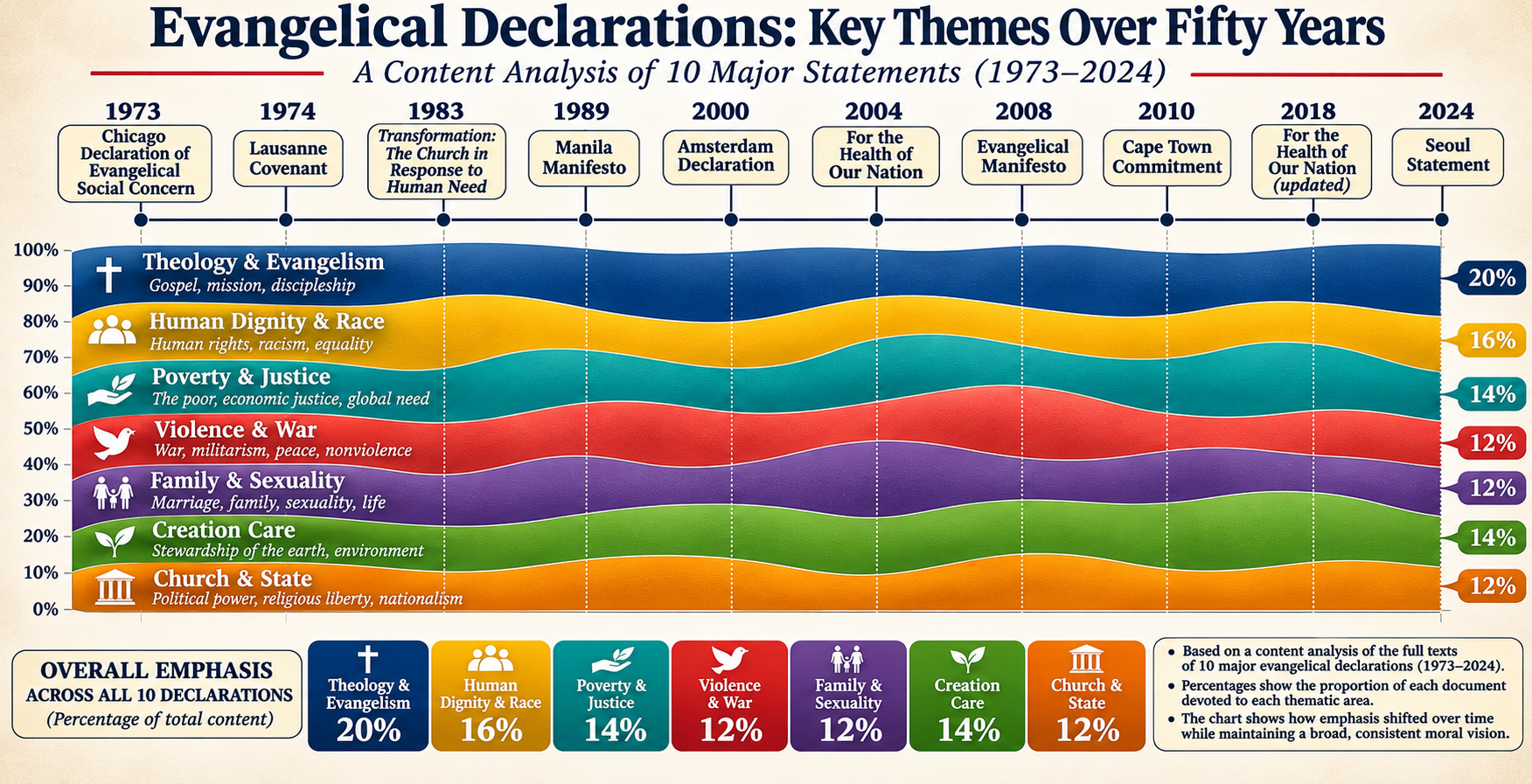
A representation of 7 key areas in evangelical declarations during my lifetime.
These aren’t competing visions of the Kingdom. They are parts of the same moral vision, even though in today’s world some sound more red, and some more blue.
We live in a culture that wants us to choose sides. Conservative or liberal. Once we've chosen a side, there's a temptation to think that the moral concerns our side emphasizes are the ones that really matter while minimizing the ones “they” think are important. What if they are all important?
Jesus and his vision for the Kingdom doesn't fit neatly into our political categories. We aren't beholden to a side of the Empire. We follow Jesus wherever he leads. Every day, our lives are making a declaration about what we believe God is like. If we believe that God is just like Jesus, then perhaps the most important question we can ask ourselves is this:
When people encounter us, are they getting an accurate picture of Jesus?
Like I said earlier, we're going to return to the book of Acts, in which a community of believers trying to figure out what it meant to act as followers of Jesus in a world that didn't often share their convictions. They didn't always get it right. They had prejudices, disagreements, and blind spots. They sometimes struggled to live up to the implications of the gospel they proclaimed. #thatsoundprettynormal
But the Spirit kept working among them, teaching them what it meant to become a community that looked like Jesus. As that happened, they changed the world.
That's my prayer for us. May our minds become increasingly aligned with the mind of Jesus. May our hearts increasingly reflect his radically forgiving, self-giving, co-suffering love. May our actionsincreasingly demonstrate the character of Jesus to the world around us.
___________________________________________________________________________________
[1] I encourage you to find these online and read them in their entirety. You will find that our statement of faith aligns with a consistent orthodoxy ‘through line’ over the 50 year time span.
[2] It was designed to elaborate, clarify, and update the 1974 Lausanne Covenant.
[3] The manifesto was initially endorsed by roughly 75 to 80 leaders including Leith Anderson, Jim Wallis, Max Lucado, Mark Noll, Miroslav Volf, Darrell Bock, J.P. Moreland, Alvin Plantinga, Ron Sider, Samuel Rodriguez, Kay Arthur, and Jack Hayford. Interestingly, James Dobson, Tony Perkins, and Albert Mohler Jr. declined to participate, contending that the manifesto's focus on political civility diluted vital stands on cultural issues.